

Avoiding Cheap Custom Apparel Prints: 2026 Guide
Table of Contents
- Common Custom Apparel Printing Mistakes That Cost You Money
- Best DTG vs DTF Printing: Which Method Actually Lasts
- Why Custom Prints Crack After Washing
- How to Audit a Print Shop Before You Order
- File Preparation Standards That Separate Pro Prints From Cheap Ones
- Spotting Cheap Custom Apparel Prints Before You Buy
- Conclusion
- Frequently Asked Questions
Last Updated: September 18, 2026
Common Custom Apparel Printing Mistakes That Cost You Money
The fastest way to waste money on custom apparel is ordering before you understand how prints fail. Cheap custom apparel prints look fine on day one; the problems show up after the first wash.
- Choosing a print method based on price alone
- Skipping the file prep that makes or breaks print clarity
- Never testing a sample before committing to a bulk order
Best DTG vs DTF Printing: Which Method Actually Lasts
The best DTG vs DTF printing comparison comes down to how each method bonds ink to fabric. DTF transfers generally outlast DTG prints on cotton blends and dark garments, while DTG works well for light, 100% cotton shirts with simple designs.

The Three Ink Families You'll Actually Encounter
Most apparel decoration uses one of three ink types. Knowing which one a shop runs tells you more about print longevity than any marketing claim.
- Plastisol, a PVC-based ink that sits on top of the fabric and cures into a flexible plastic film. It's the workhorse of screen printing. It's opaque, vibrant, and durable, but it feels like a layer on the shirt and can crack if it's under-cured or stretched past its tolerance.
- Water-based ink, dye-like ink that soaks into cotton fibers instead of sitting on top. It feels like nothing on the shirt and fades gradually rather than cracking. It's the standard for DTG and for discharge-style screen printing, but it's less opaque on dark garments without a white underbase.
- DTF transfer film, a printed film coated with a thermoplastic adhesive powder that's heat-pressed onto the garment. The adhesive is what actually bonds to the fabric, so the bond quality depends on powder type, press temperature, and dwell time as much as the ink itself.
How DTG Ink Sits in the Fabric
Direct-to-garment printing sprays water-based ink onto the shirt, where it soaks into the cotton fibers and bonds at the surface.
How DTF Transfers Bond to the Surface
Direct-to-film printing prints your design onto a film, dusts it with adhesive powder, then heat-presses it onto the garment, leaving a flexible layer on top of the fabric.
Matching the Method to the Garment
A quick decision framework:
- Light 100% cotton tee, simple design → DTG is a strong fit. Soft hand, low setup cost.
- Dark tee, detailed or multi-color design → DTF. The transfer holds color and detail that DTG struggles to reproduce on dark fabric.
- Polyester performance wear → DTF or a dye-sublimation process. Standard DTG will bond poorly.
- Large bulk run of one design on cotton → Screen printing with plastisol or water-based ink is usually the most cost-effective and durable option.
The mistake is picking a method because it's the cheapest quote. The right question is which method matches your fabric and design, the wrong match produces a print that looks cheap in three washes.
Why Custom Prints Crack After Washing
Custom prints crack after washing because of poor ink adhesion, not the wash itself. When the ink or transfer layer doesn't fully bond, flexing and heat break it down fast.
Watch for these warning signs:
- Peeling edges after one or two washes
- Fine spiderweb cracks across the design
- Fading color that looks washed out
- Stiff, plastic-feeling patches that flake
A Repeatable Sample Audit You Can Run at Home
You don't need lab equipment to stress-test a print, just a sample, a washing machine, and a way to record results. Here's a protocol most buyers skip:
- Baseline photo. Photograph the print flat, under even light, before any washing. Note the date.
- Flex test first. Stretch the printed area in both directions with your thumbs. A properly cured print flexes without a white stress line forming at the edges. If you see a light-colored crease appear, the ink is already at its limit.
- Wash inside out, cold water, gentle cycle. Heat is the enemy of adhesion, so a cold wash isolates the mechanical stress from the thermal stress.
- Tumble dry low, or air dry. Air drying is the harsher test for adhesion because there's no heat to re-soften the ink, if it survives air drying, it's bonded well.
- Repeat five times. Photograph after each cycle from the same angle and distance as your baseline.
- Compare at the end. Look for edge lifting, color shift, and crack formation. A print that looks identical to the baseline after five cycles is a print that was cured correctly.
What Each Failure Mode Actually Tells You
The way a print fails is diagnostic. Different failures point to different production problems:
- Cracks radiating from the edges inward → under-cured ink. The center bonded, the edges didn't.
- Uniform spiderweb cracking across the whole design → the ink film is too thick, or the garment stretched more than the ink could follow.
- Peeling in sheets, starting at a corner → DTF adhesive failure. Wrong powder, wrong press temperature, or too little pressure.
- Color fading without cracking → water-based or DTG ink that was never fully cured, or a garment washed in hot water repeatedly.
- Stiff patch that flakes → plastisol applied too heavy and cured too fast, trapping solvent under the surface.
Why the Wash Itself Is Rarely the Real Problem
It's tempting to blame the washing machine, but a correctly produced print survives normal home laundering for the life of the garment. If a print fails in five washes, the failure was baked in at production, the wash just revealed it. The sample audit moves that discovery from your customer's laundry room to your own.
WANTED: MAC BEAR TEE — PREMIUM →
How to Audit a Print Shop Before You Order
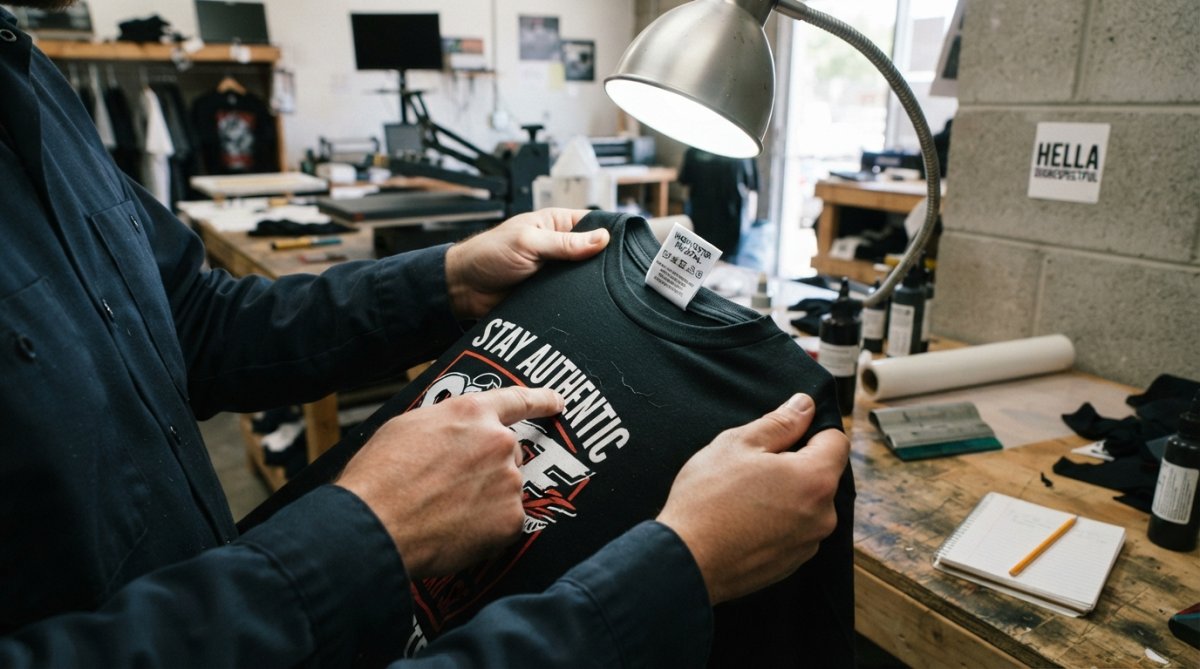
You audit a print shop by asking direct questions about their methods, testing a sample, and checking print clarity up close. A shop that can't answer basic production questions cuts corners.
Questions That Expose Weak Production Standards
Ask these before you pay:
- What ink or film do you use, and how is it cured?
- Can I see a wash test on this exact fabric?
- What's your minimum order quantity, and does quality change at higher volume?
- How do you handle color matching across a bulk run?
- What's your policy if prints crack or peel?
A confident shop answers all five without hesitation. A weak one dodges, rushes, or promises results they can't back up.
File Preparation Standards That Separate Pro Prints From Cheap Ones
File preparation decides whether your print looks crisp or muddy. Vector graphics and high-DPI files produce clean prints. Low-resolution images produce blurry, pixelated results no matter how good the printer is.
Follow these standards before you upload anything:
- Use vector graphics (SVG, AI, EPS) for logos and text
- Keep raster images at 300 DPI at final print size
- Use a transparent PNG for DTF and DTG
- Design in the correct color mode (RGB for most apparel printing)
- Leave a clean margin so the print doesn't run into seam lines
Spotting Cheap Custom Apparel Prints Before You Buy
You can spot cheap custom apparel prints before you buy by checking fabric weight, print placement, and finish. Thin blanks and sloppy placement are the giveaway signs.
Look for these red flags:
- Lightweight fabric that feels flimsy in hand
- Off-center or crooked print placement
- Dull, flat color instead of vibrant ink
- Stiff transfer patches that crack when you flex them
- Loose stitching at the collar and seams
| Red Flag | What It Signals | What to Do Instead |
|---|---|---|
| Flimsy, thin fabric | Cheap blank that won't hold shape | Choose heavyweight cotton |
| Crooked print placement | Rushed production | Ask for a placement proof |
| Dull, flat color | Low-quality ink or film | Request a sample print |
| Stiff, cracking transfer | Poor ink adhesion | Ask for a wash test |
| Loose collar stitching | Weak garment construction | Check side-seamed builds |
Conclusion
Getting a print that lasts comes down to asking the right questions and refusing to settle for the cheapest quote. Cheap custom apparel prints cost more in the long run, every time.
Frequently Asked Questions
What are the signs of low-quality custom apparel printing?
Look for blurry or pixelated edges, uneven ink coverage, and prints that feel like a thick plastic sheet on top of the fabric. Check the collar and seams for crooked stitching. Ask whether the shop uses plastisol or water-based ink, and whether they run wash tests. A print that looks dull or faded on arrival will only get worse. High-quality DTF transfers from a shop like Hella Disrespectful press clean and hold vibrant color through repeated washing.
Why do custom t-shirt prints crack or peel after a few washes?
Cracking happens when the ink layer is too thick, the heat press temperature was wrong, or the garment was washed inside out in hot water. Low-quality transfers also fail because the adhesive layer breaks down. Properly applied DTF prints bond to the fabric surface and flex with it. Wash in cold water, turn the shirt inside out, and skip the dryer to extend print life significantly.
What is the difference between DTG and DTF printing quality?
DTG (direct-to-garment) sprays ink directly into the fabric fibers, which works best on 100% cotton and can look faded on dark colors. DTF (direct-to-film) prints a transfer that bonds to the surface, delivering sharper detail and brighter color on cotton, polyester, and blends. For streetwear with bold graphics, DTF holds up better through washing and keeps color vibrancy longer.
Does the fabric choice affect the quality of custom prints?
Yes. Fabric weight and fiber content determine how well ink adheres and how the print wears over time. Heavyweight ring-spun cotton, like the 6.5 oz fabric used in Hella Disrespectful's premium tees, gives the print a stable surface that resists cracking. Blends with polyester can shift color results. Always match your printing method to the garment rather than forcing one method onto every fabric.