

Custom Printing for Local Brands: 2026 How-To Guide
Table of Contents
- Step 1: Choose Your Printing Method for Custom Printing
- Step 2: How to Start a Clothing Brand with Custom Printing
- Step 3: Master File Preparation for Vector Graphics and Clean Prints
- Step 4: Quality Control for Custom Clothing Brands
- Step 5: Order Bulk Apparel Without Sacrificing Consistency
- Step 6: Evaluate Costs and Turnaround for Local Brand Printing
- Step 7: Build Brand Identity with Promotional Products and Apparel
- Step 8: Source Sustainably: Eco-Friendly Printing and Certifications
- Frequently Asked Questions
Last Updated: September 15, 2026
Step 1: Choose Your Printing Method for Custom Printing
Custom printing for local brands starts with one decision: the method. Get it wrong and you'll fight color matching, cracked ink, and bad margins.
Two methods dominate small-batch apparel. Direct-to-Garment (DTG) sprays water-based ink directly onto the shirt, soaking into the cotton fibers. Direct-to-Film (DTF) prints the design onto a film, dusts it with adhesive powder, then heat-presses it onto the garment.
The difference comes down to fabric and feel. DTG looks best on 100% cotton, producing a soft, vintage-style print inside the fabric. DTF bonds to the surface, so it works on cotton, polyester, blends, and even nylon, the default for small brands printing mixed blanks.
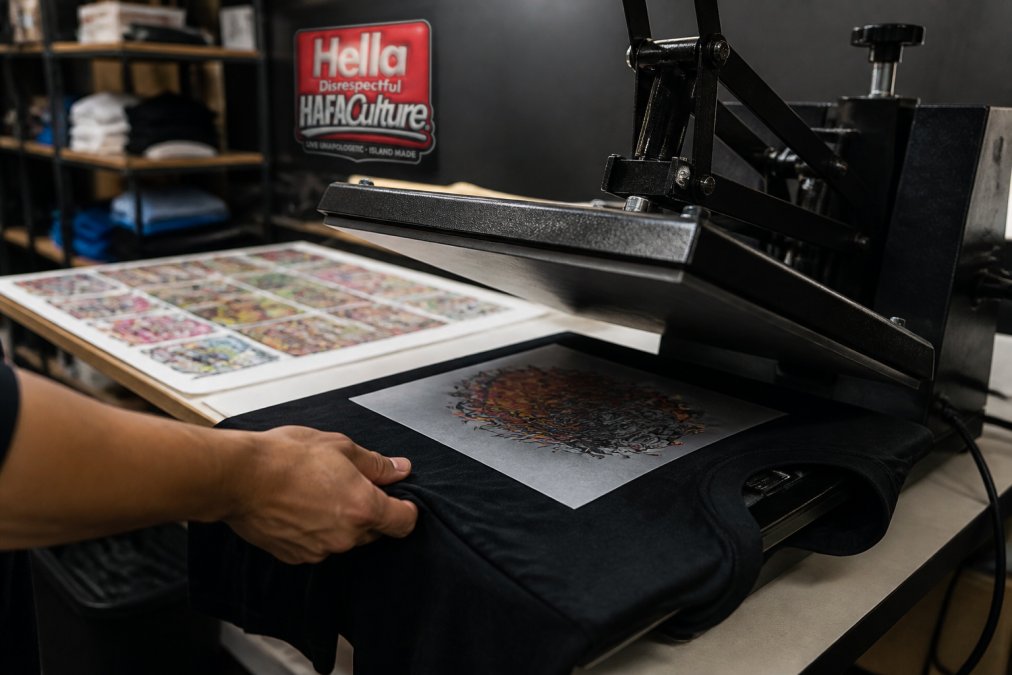
Best DTG vs DTF Printing: Which Wins for Local Brands?
DTF is a versatile option for many local brands: one method can cover various fabrics. A brand doing 50 shirts across cotton tees, poly hoodies, and canvas totes can run all of it through DTF without switching processes.
| Factor | DTG | DTF |
|---|---|---|
| Fabric compatibility | Cotton-heavy | Nearly any fabric |
| Print feel | Soft, in-fabric | Slight surface texture |
| Dark garments | Needs pretreatment | Handles well |
| Small-batch friendly | Moderate | Yes |
| Best for | Cotton tees, soft hand | Mixed blanks, poly, totes |
Step 2: How to Start a Clothing Brand with Custom Printing
Starting a clothing brand with custom printing is about the order you do things. Most first-timers print first and figure out positioning later. That's backwards.
Here's the sequence that actually works:
- Define who the brand is for and what it stands for
- Source blanks that match your price point and quality bar
- Lock in your printing method and a print partner
- Design 3-5 pieces for a small first drop
- Test with a limited run before committing to volume
- Sell, learn, and scale what works
Hella Disrespectful Clothing offers bold, unapologetic designs for people who value authenticity over external validation. Its Hafa Culture series is an example of a specific point of view.
The blank matters as much as the print. Heavyweight cotton can feel more premium.
Step 3: Master File Preparation for Vector Graphics and Clean Prints
Clean prints start with clean files. Most brands rush this step, causing the most reprints.
Vector graphics are built from mathematical paths rather than pixels, so they scale to any size without losing sharpness (Vector art: What is vector art?). Logos and line art should always be vector. Raster images, like photos, blur when enlarged.
Before you send anything to print, run this checklist:
- Convert all text to outlines so fonts don't shift
- Set your file to 300 DPI at final print size for raster elements
- Use CMYK color mode and check Pantone references for brand colors
- Add a transparent background (no white boxes behind the design)
- Leave a small margin so edges don't get cut off
File format matters too. Most shops accept PNG, PDF, or AI files. A low-resolution JPEG from a phone screenshot is the fastest way to a rejected print.
Step 4: Quality Control for Custom Clothing Brands
Quality control for custom clothing brands is a system, not a vibe check. You need checkpoints at every stage, or defects reach customers.
Start with an incoming inspection of your blanks: check for crooked seams, deformed necklines, and inconsistent sizing before printing. A shirt with a bad neckline is a bad shirt no matter how good the print looks.
After pressing, inspect each piece for:
- Ink that peels or cracks at the edges
- Misaligned placement (centered designs should actually be centered)
- Color that doesn't match your approved proof
- Heat-press marks or scorching on the fabric
Cheap blanks and rushed pressing cause stretched or warped collars, and customers notice. A quick stretch test on the collar before packing catches most of it.
Step 5: Order Bulk Apparel Without Sacrificing Consistency
Bulk orders fail for one reason: inconsistency. Order 200 shirts and you might get 200 slightly different prints if your provider doesn't control the process.
Consistency comes from three things: the same blanks, print method, and provider across the run. Switching any mid-order introduces variation.
Minimum order quantity (MOQ) and setup fees trip up small brands. Some charge a setup fee per design, making small runs expensive. Others set an MOQ that forces you to over-order before testing demand.
If you're scaling a brand, ask your print partner these questions before committing to a bulk order:
- Do you guarantee color consistency across the full run?
- Is there a setup fee per design or per order?
- What's the turnaround time for reorders?
- Can you handle a mix of sizes and styles in one order?
Step 6: Evaluate Costs and Turnaround for Local Brand Printing
Cost and speed are the two levers every brand pulls, but the real skill is matching the method to your budget and durability needs. "Buy more, pay less" is nearly useless when deciding between a 24-piece test drop and a 200-piece restock.
Here's the framework that actually helps.
The Four Cost Buckets
Every custom printing quote breaks into the same parts:
- The blank, the garment itself. Heavyweight cotton and premium blends cost more per unit than standard tees.
- The print, ink, film, labor, and machine time. This is where method choice moves the number most.
- Setup, screen burning, digitizing, or file prep. Some methods charge per design; others fold it into the unit price.
- Shipping and finishing, folding, tagging, bagging, and freight.
For small runs, per-unit print cost is high because fixed costs spread across fewer pieces. As quantity climbs, per-unit cost drops, but only for methods with low setup. DTF has low or no setup, so it is suitable for small runs and can remain competitive as you scale.
Choosing by Budget and Durability
Use this decision logic before you request a quote:
- Testing a design (1-24 pieces): DTF or DTG.
Turnaround Realities
A Worked Example
| Order Type | Best For | Cost Structure |
|---|---|---|
| Single DTF print | One-off designs, testing | $2.00 per design |
| Custom DTF gang sheet | Multiple designs in one run | From $14.00 per sheet |
| Add-on services | Rush or fully finished orders | $5.00 and up |
The Durability Question
Step 7: Build Brand Identity with Promotional Products and Apparel
Beyond tees, consider:

Step 8: Source Sustainably: Eco-Friendly Printing and Certifications
Inks and Processes
What the Certifications Actually Mean
Making Claims You Can Defend
The Cost Trade-Off
Frequently Asked Questions
What is the difference between DTG and DTF printing for apparel?
DTG (direct-to-garment) printing sprays ink directly onto fabric, working best on 100% cotton. DTF (direct-to-film) printing transfers a design from a film onto the garment using heat, and it adheres well to cotton, polyester, and blends. DTF typically produces more vibrant colors on dark fabrics and has lower minimum order requirements, making it a strong choice for local brands testing new designs without committing to large runs.
How do I choose the right printing method for my clothing brand?
Start by matching the method to your fabric and order size. If you're printing on 100% cotton tees in small batches, DTG can work. For blends, dark garments, or designs needing high color accuracy, DTF often delivers better results. Consider your budget, turnaround time, and whether you need no-minimum options. Many local brands begin with DTF gang sheets to test multiple designs cost-effectively before scaling up.
What should I look for in a high-quality custom printing partner?
Look for clear pricing, no hidden setup fees, and consistent color matching. Ask about ink durability and how the print holds up after repeated washing. A good partner offers design file guidance, quick turnaround options, and transparent communication about minimum order quantities. If you're ordering bulk, request a sample first to check print quality and garment construction before committing to a full run.
How can custom apparel help build brand identity for small businesses?
Custom apparel turns your logo and message into wearable marketing. When customers or employees wear your branded gear, it creates visibility and signals authenticity. For local brands, offering unique designs that reflect your community or niche builds connection. Consistent quality and thoughtful design choices, like color matching to your brand palette, make the apparel feel like a genuine extension of your business rather than generic merchandise.
Building a brand on custom printing means getting the details right: the method, the files, the quality control, and the sourcing. Hella Disrespectful Clothing handles the printing side with no minimums, high-quality DTF transfers, and heavyweight apparel built to last, plus add-on services like rush turnaround when a drop can't wait. Get started with Hella Disrespectful Clothing and turn your designs into merch that speaks for itself.