

How to Verify Limited Edition Streetwear: 7-Step Legit Check
Last Updated: October 22, 2026
Quick Summary
To verify limited edition streetwear, first confirm the exact drop's release date, colorways, size run, and sales channel against the brand's own records, then check that any edition number falls inside the documented run. Labels, stitching, serials, and provenance must all agree with that release before you pay.
- A piece numbered above the announced edition size is counterfeit or misdescribed.
- Compare serial and edition formats against authentic examples from the same brand and era.
- Resolve codes through the brand's official verification page, not third-party lookup sites.
- Save the listing, request tag photos, and pay through a protected method before money changes hands.
- Legit check apps miss subtle construction flaws and cannot confirm provenance or seller history.
Table of Contents
- Start With the Release Details, Not the Hype
- Check Labels, Care Tags, and Tag Placement
- Inspect Logos, Fonts, Graphics, and Stitching
- Verify Serial Numbers, Barcodes, and Authentication Tags
- How to Spot Fake Streetwear: Packaging, Accessories, and Provenance
- Using a Streetwear Legit Check App (and Knowing Its Limits)
- Buying Limited Edition Streetwear Secondhand: Evidence and Dispute Steps
- Conclusion
- Frequently Asked Questions
Start With the Release Details, Not the Hype
Learning how to verify limited edition streetwear starts with one rule: verify the release before you look at a single stitch. Most fakes fall apart here, not at the logo.
Limited edition streetwear is apparel produced in a fixed, announced quantity, often tied to a specific release date, edition size, and set of official release details. The scarcity is documented, not implied.
Step 1: Pin down the exact drop
Before comparing tags or stitching, identify the specific release. A generic "limited hoodie" claim is unverifiable; a specific drop is checkable. Nail down these five data points from the brand's own announcement, lookbook, or archive page:
- Drop name and season: e.g., a named capsule or seasonal collection, not just the brand.
- Release date: The day the drop went live, including time zone if the brand announced one.
- Colorways produced: Which colorways actually existed, and which were sample-only or cancelled.
A seller claiming a piece came from a drop that never happened is the oldest trick in the book. If the story doesn't match the release, walk away. No photo of a receipt fixes a release that doesn't exist.
Step 2: Verify the edition claim itself
This is where most buyers stop too early. "Limited" is marketing language until you can tie it to a documented cap. Work through these checks:
- Is it numbered? Look for an edition number printed, embroidered, or on a hangtag, commonly formatted as a number over the total run (for example, a piece marked as number 47 of 200). The format should match how the brand numbers its other releases.
- Does the number fall inside the stated run? A piece numbered above the announced edition size is counterfeit or misdescribed.
- Is the cap documented anywhere public? Check the brand's release post, product page archive, or press notes for a stated quantity. If the brand never published a number, treat "limited" as unverified rather than proven.
Step 3: Cross-check the story against the records
Once you have the drop details and the edition claim, compare them to what the seller tells you. The release date, colorway, size run, and numbering should all line up.
brand release archive or lookbook page for the specific drop
This release-first workflow is what separates a real verification from a vibe check. Generic label and logo inspections catch sloppy fakes, but release-specific checks catch the good ones, the fakes built on a real garment with a fabricated scarcity story.
Check Labels, Care Tags, and Tag Placement
Labels are where counterfeiters get lazy. A real tag sits flat, prints clean, and matches the brand's known format. A fake often has blurry text, wrong fonts, or a care tag stitched in the wrong spot.
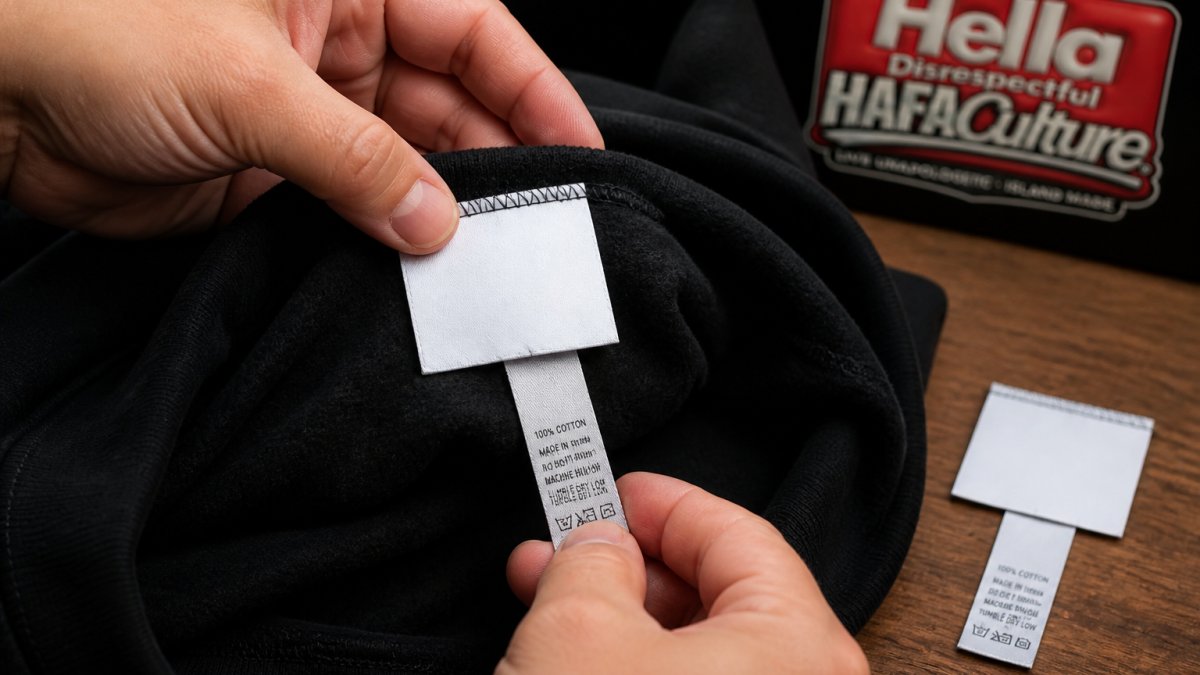
Work through these checks:
- Neck label: Is the font crisp? Does the spacing look even?
- Care tag: Does it list real fiber content and washing instructions?
- Tag placement: Is it centered, or crooked and rushed?
Tag placement is the tell most people miss. Mass-produced fakes get sewn fast, so tags drift off-center or sit too high. Turn the garment inside out and look closely.
Inspect Logos, Fonts, Graphics, and Stitching
Graphics and logos are the most faked part of any drop, and also the easiest to compare.
Look at these details:
- Font: Does the lettering match the brand's real typeface?
- Spelling: Are there typos or missing letters?
- Alignment: Are graphics centered and level?
A common mistake is judging a graphic from a phone screen at an angle. Get flat, well-lit photos, front and back.
Construction matters as much as the print. Check the seams, the hem, and the cuffs. Sloppy stitching and loose threads point to a rushed fake, not a real drop.
Verify Serial Numbers, Barcodes, and Authentication Tags
Serial numbers, barcodes, and authentication tags add a paper trail, but they are not proof on their own. Counterfeiters copy codes, print fake tags, and clone barcodes all the time. The mistake buyers make is treating a scannable code as a verdict. Treat it instead as one data point that has to agree with everything else.
“Disrespect the Norm – Mystery Box” →
What each identifier can and cannot tell you
- Serial number: Can confirm a format and, if the brand publishes records, a production range. Cannot confirm the garment it is attached to is genuine, serials get transplanted onto fakes.
- Barcode: Can confirm the code resolves to the correct product listing. Cannot confirm the physical item matches that listing.
- Authentication tag or QR code: Can confirm the code exists in a database. Cannot confirm the code was not copied from a real item and reused.
A practical cross-check workflow
Run these checks in order, and stop if any one fails:
- Read the format, not just the number. Compare the serial or edition format against known authentic examples from the same brand and era. Formatting changes between production years, so match the era, not just the brand.
- Check the number against the stated run. If the brand announced an edition size, the number should fall inside it. A number above the cap is a hard fail.
- Resolve the code through the brand's own page. Scan or enter the code on the brand's official verification page, not a third-party lookup site that may be scraping or faking results.
- Cross-check the tag against the garment. Does the tag's material, stitching, and placement match the rest of the piece? A perfect code on a sloppy tag is a transplanted tag.
- Cross-check against construction and release details. The identifier has to agree with the drop, the colorway, the materials, and the stitching all at once. One agreement is weak; four agreements is a strong signal.
Watch for these failure patterns
- Same code on multiple listings: A reused serial showing up across sellers is a cloned code.
- Code resolves to a different product: The tag was pulled from another item.
- No format match for the era: A modern serial format on a piece claimed to be from an older drop.
Treat these identifiers as one piece of evidence, not the whole case. A real serial number on a fake garment is common. The tag has to match the item, the release, and the construction all at once, and when it does not, the code is the thing to distrust, not the garment.
How to Spot Fake Streetwear: Packaging, Accessories, and Provenance
Knowing how to spot fake streetwear comes down to the details around the garment, not just the garment itself. Packaging, extras, and provenance tell the story of where a piece has been.
Check these areas:
- Packaging: Does the bag, box, or wrap match the brand's real packaging?
- Accessories: Are the extra laces, stickers, or cards included and correct?
- Condition: Does wear match the seller's story and the item's age?
Provenance is the strongest signal. A real order confirmation, a matching receipt, and a believable seller history beat any single tag. Ask for the original proof of purchase and compare the details to the item.
Using a Streetwear Legit Check App (and Knowing Its Limits)
A streetwear legit check app can speed up a decision, but it is a helper, not a judge. These apps compare photos against known references and flag mismatches, and that's useful for a first pass.
What apps do well:
- Quick photo comparison against known real pieces
- Community checks from other collectors
- A second opinion before you commit
Where they fall short:
- They miss subtle construction flaws
- They can't confirm provenance or seller history
- They struggle with legitimate variations between eras and factories
That last point matters. Real brands change factories, tags, and materials over time, so two authentic pieces can look different. An app that flags a genuine variation will cost you a good buy.
Buying Limited Edition Streetwear Secondhand: Evidence and Dispute Steps
Buying limited edition streetwear secondhand means collecting evidence before you pay, not after. The goal is a paper trail strong enough to win a dispute if the item turns out fake.
Build your evidence file with these steps:
- Save the listing with photos, price, and description.
- Request extra photos of tags, stitching, and serial numbers.
- Get the seller's proof of purchase in writing.
- Pay through a protected method that offers buyer protection.
- Keep every message in one place.
If the item arrives and something's wrong, act fast. Open a dispute through your payment platform, attach your evidence file, and describe the specific mismatch. Most platforms side with buyers who documented the process. Skip the evidence and you're stuck arguing with screenshots you never took.
Conclusion
Verifying a drop takes patience, and most people skip it because the hype feels urgent. Slow down, check the release details, and collect evidence before you pay. That habit protects your money and keeps fakes out of your closet.
When you want a real drop from a brand that stands behind its work, Hella Disrespectful Clothing builds bold, independent pieces with custom DTF printing for your own designs.

Frequently Asked Questions
What details should I check on limited edition streetwear?
Start with the release details: the announced drop date, edition size, colorway, and included accessories, then compare them against the item in hand. Move on to the neck label, care tag, and tag placement, which should match the brand's known format. Check logo fonts, graphic alignment, and stitching density. Finally, look for a serial number, barcode, or authentication tag and confirm it matches the release. Any single mismatch is a reason to slow down, and two or more mismatches usually mean you should walk away.
Is there a streetwear legit check app that can authenticate clothes?
Several apps and online authentication services let you upload photos of tags, stitching, and labels for review, and some use trained reviewers rather than software alone. Treat them as a second opinion, not a verdict. A legit check app works best when you send clear close-ups of the care tag, neck label, and any serial or authentication tag, plus the seller's proof of purchase. No app can confirm provenance, so pair the result with release details and seller history before you pay.
Can a receipt or proof of purchase confirm streetwear authenticity?
A receipt helps, but it is not proof on its own. Order confirmations and receipts can be edited or reused, so ask for a screenshot showing the order number, date, and item name, and check that the date lines up with the release. Pair it with the seller's history and photos of the actual item, not stock images. For expensive pieces, ask whether the original packaging and accessories are included, since those are harder to fake convincingly than a PDF receipt.
What should I ask a seller before buying limited edition streetwear secondhand?
Ask for the original order confirmation with a visible date and order number, close-up photos of the neck label, care tag, and any serial or authentication tag, and photos of the packaging and included accessories. Request a short video showing the item from multiple angles, since video is harder to fake than stills. Confirm the return policy and whether the sale is protected by the platform. If a seller dodges any of these requests or pushes you to pay off-platform, treat that as a red flag and move on.
Ready to skip the fakes and wear something with a real story? Shop the drops at Hella Disrespectful Clothing and get heavyweight apparel built to stand out, plus custom DTF printing when you want your own design on it.