

Ocean Motifs in Chamorro Art: Symbolism Guide
Table of Contents
- Why the Ocean Runs Through Chamorro Art
- CHamoru Art and Cultural Symbols: What the Evidence Actually Shows
- CHamoru Canoe and Navigation Symbolism
- CHamoru Pottery Designs and the Sea
- Fish, Waves, and Other Marine Motifs, One by One
- Latte Stones, Cave Art, and Ancestral Ocean Imagery
- Using Ocean Motifs in Clothing Design Respectfully
- Conclusion
- Frequently Asked Questions
Last Updated: October 20, 2026
Why the Ocean Runs Through Chamorro Art
The symbolism of ocean motifs in Chamorro art starts with a simple fact: for the CHamoru people of the Mariana Islands, the sea was never scenery. It was the road, the pantry, the graveyard, and the calendar.
At Hella Disrespectful Clothing, we design around CHamoru heritage every day, and we've learned that the ocean symbolism people ask about most is also the most misunderstood. Below, we'll separate what's documented from what's modern interpretation, walk through the motifs one by one, and show how to wear or design them without flattening them.
The short answer on meaning: ocean motifs in Chamorro art are best understood as records of practical knowledge (navigation, fishing, tides) layered with ancestral story, not as a fixed dictionary of secret symbols.
CHamoru Art and Cultural Symbols: What the Evidence Actually Shows
CHamoru art and cultural symbols are a mix of archaeological record, oral tradition, and living practice, and those three sources don't always agree. That's not a flaw. It's the honest starting point.
Documented Meanings vs. Modern Interpretations
Documented meanings come from archaeology, ethnography, and CHamoru oral histories recorded by community members. Modern interpretations come from contemporary artists, designers, and yes, apparel brands. Both exist. They are not the same thing.
A common mistake is treating a modern design choice as ancient doctrine. If a wave spiral appears on a shirt, that's a design decision, not a recovered ancestral code.
Regional and Community Variation
Motifs vary across Guam, the Northern Mariana Islands, and CHamoru communities in the diaspora. Families and villages carry different stories about the same shapes. A fish figure on one island may connect to a specific fishing practice; elsewhere the same figure reads differently. Treat variation as the norm, not an inconsistency to resolve.
CHamoru Canoe and Navigation Symbolism
CHamoru canoe and navigation symbolism is where the ocean motifs get most literal. The canoe is not just transportation in CHamoru history; it's the technology that made settlement and trade across the Marianas possible.
Stars, Currents, and the Visual Language of Wayfinding
Traditional wayfinding relied on star positions, swell direction, current behavior, and bird movement. When those systems show up in art, they appear as repeated geometric marks, directional lines, and star-like clusters. As documented by the Smithsonian's Pacific cultural heritage collections, Pacific navigation knowledge was carried through both practice and performance, including chant and story.
A practical rule for designers: a star motif and a wave motif placed together usually reads as a wayfinding reference. That's an interpretation, not a translation. Say so when you write about it.
CHamoru Pottery Designs and the Sea
CHamoru pottery designs often carry incised and impressed patterns, and marine references show up in the tool marks themselves. Shell impressions, cord-marking, and combed lines can all read as water or scale textures depending on how they're applied.
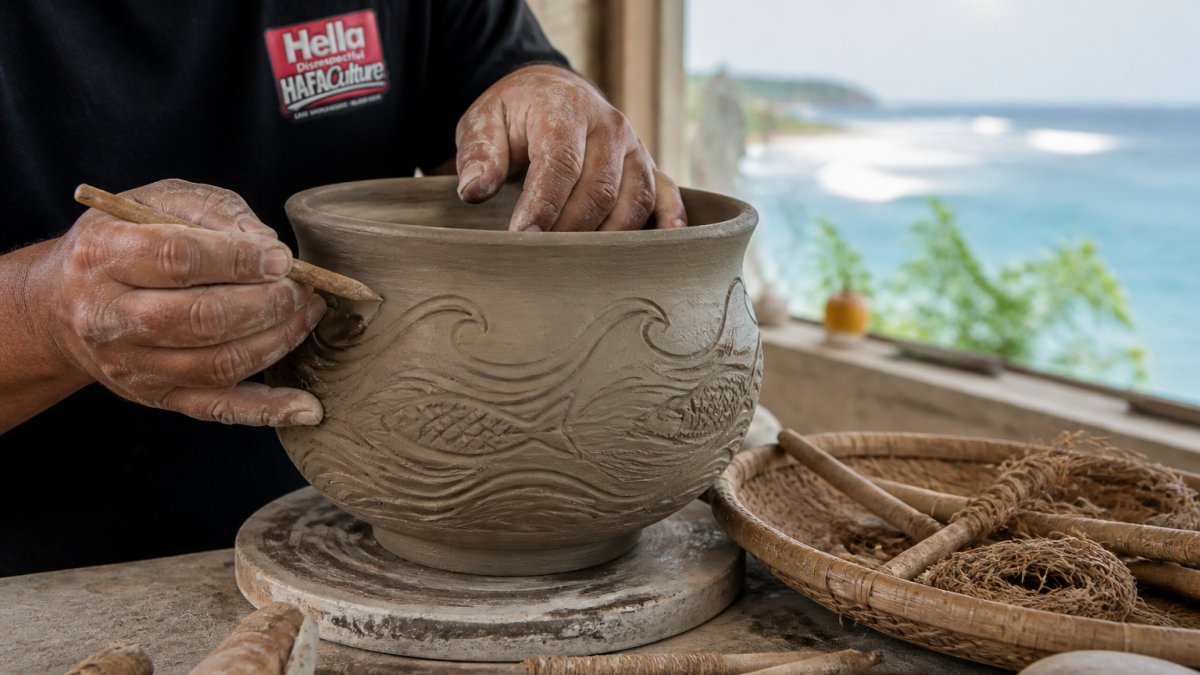
Here's what most guides miss: the pattern often comes from the tool, not from a symbolic program. A shell pressed into wet clay leaves a shell shape. That doesn't automatically mean the maker was invoking the sea spirit. It means they used what was at hand, which in an island context was usually marine material.
Fish, Waves, and Other Marine Motifs, One by One
Most roundups of Chamorro symbols list fish, waves, and canoes and stop there. That's not a guide; it's a word cloud. A useful motif-by-motif treatment has to do three things per motif: describe the visual form, name where it actually appears in the record, and state plainly whether the meaning is documented, inferred, or a modern reading. Here is that treatment.
Fish figures
Visual form: Single fish in profile, often with a triangular body, incised fins, and a hatched or cross-hatched interior; sometimes paired or in schools.
Where it appears: Incised on pottery sherds, pecked into rock surfaces, and in contemporary carving and tattoo work.
What is documented: Fish are tied to subsistence, reef fishing, trolling, and netting were central to coastal life across the Marianas, and fish remains are common in archaeological midden deposits.
What is inferred: Abundance, fertility, and clan or family association are common readings, but they are inferences drawn from context, not translations from a known symbol system.
What is modern: The stylized 'island fish' used in apparel and logo design is a contemporary graphic convention.
Wave and spiral lines
Visual form: Parallel incised lines, running scrolls, spirals, and combed bands; sometimes continuous around a vessel's shoulder.
Where it appears: Pottery (especially incised and combed wares), woven fiber goods where the weave itself creates a wave-like band, and contemporary graphic art.
What is documented: Many wave-like marks are tool-derived.
What is inferred: Currents, movement, and the sea's rhythm are reasonable readings when the lines are deliberate and paired with other marine imagery.
What is modern: The 'wave band' as a decorative border in surf and island branding is a modern design trope with no direct line to a specific ancestral meaning.
Star clusters and wayfinding marks
Visual form: Small grouped dots or crosses, radiating lines, and directional chevrons.
Where it appears: Rarely as standalone ancient motifs; more often in contemporary art that draws on navigation knowledge, and in chant and performance traditions rather than fixed visual symbols.
What is documented: Pacific wayfinding relied on star positions, swell direction, current behavior, and bird movement. That knowledge was carried through practice, chant, and story, as documented in the Smithsonian's Pacific cultural heritage collections Smithsonian Pacific cultural heritage collections.
What is inferred: A star motif paired with a wave or canoe reads as a wayfinding reference. That is an interpretation, and it should be labeled as one.
Mermaid of the Marianas Women’s Tank 🌊 →
What is modern: Compass roses, star charts, and 'navigator' graphics in contemporary Pacific design are modern compositions, often pan-Pacific rather than specifically CHamoru.
Canoe forms
Visual form: Hull silhouettes, outrigger profiles, paddles, and sail shapes.
Where it appears: Contemporary carving, tattoo, and graphic art; historical voyaging is documented through archaeology, oral tradition, and replicated voyaging.
What is documented: The canoe is the technology that made settlement and trade across the Marianas possible. Voyaging history is one of the strongest-evidenced themes in the entire catalog, which is why canoe imagery carries more documentary weight than most other motifs.
What is inferred: Migration, connection between islands, and continuity across the diaspora are common readings and are well supported by the historical record.
What is modern: The outrigger as a pan-Pacific identity symbol in surf and lifestyle branding is a modern usage.
Shell impressions and marine-material marks
Visual form: Scalloped edges, fan shapes, and textured fields left by pressing shell or cord into clay.
Where it appears: Pottery surfaces, tool handles, and woven goods.
What is documented: These are usually technique, not symbol. A shell pressed into wet clay leaves a shell shape because a shell was the tool at hand. In an island context, marine material was the default toolkit.
What is inferred: A reference to the marine environment is fair; a specific spiritual meaning is not supported by the mark alone.
Human and spirit figures
Visual form: Anthropomorphic figures, sometimes with marine attributes such as fish tails or wave-like limbs.
Where it appears: Rock art, contemporary art, and story-linked imagery such as the Sirena legend.
What is documented: Meanings here are heavily community-dependent. The same figure can carry different stories in different families and villages, and some imagery is considered sensitive.
What is inferred: Ancestral story and legend are the right frame, but the specific story must be attributed to a named source, not generalized.
A quick decision rule for designers
Before you use any motif, answer three questions in order: (1) What is the visual form and where does it actually appear? (2) Is the meaning documented, inferred, or modern? (3) Can I name the specific source or community reference? If you can't answer all three, the motif isn't ready to use, and it isn't ready to write about either.
Latte Stones, Cave Art, and Ancestral Ocean Imagery
Latte stones are the most recognizable CHamoru architectural form, and their cultural significance runs through ancestral practice and identity. They're structural, ceremonial, and symbolic at once, and they anchor a lot of contemporary CHamoru art and design.
Cave art and rock imagery add another layer. These sites preserve depictions that researchers continue to interpret, and the marine references in them are not always obvious. What matters for anyone designing or writing about this material is attribution: name the site type, note that interpretation is ongoing, and avoid presenting a guess as a finding.
Using Ocean Motifs in Clothing Design Respectfully
Respectful use starts with three habits: credit the source, distinguish interpretation from documentation, and let community voices lead on meaning.
Our own approach at Hella Disrespectful Clothing is to build designs around named CHamoru references rather than generic "island vibes." The Mermaid of the Marianas Women's Tank draws directly on the Sirena legend, one of the most recognizable ocean-linked stories in CHamoru folklore. The Guåhan Culture Tee centers the latte stone and island silhouette rather than inventing symbolism. And the Pacifika Culture Tee uses voyaging canoes, waves, and a compass to represent shared Pacific heritage.


For anyone building their own pieces, our custom DTF printing lets you bring a design to us directly, so the reference stays in your hands.
Conclusion
The hardest part of working with ocean motifs isn't finding them. It's resisting the urge to assign a tidy meaning to every line. The sea in CHamoru art carries navigation knowledge, subsistence practice, ancestral story, and living identity all at once, and the honest approach is to say which one you're drawing on.
We build our drops around named references, not vague island aesthetics. If you want apparel that carries specific CHamoru imagery, from the Sirena legend to the latte stone, browse the Hafa Culture collection at Hella Disrespectful Clothing and wear something you can actually explain.
Frequently Asked Questions
What do ocean motifs represent in Chamorro art?
Ocean motifs in Chamorro art most often represent survival, movement, and connection. Fish and wave patterns point to a diet and daily life built on fishing and coastal living, while canoe and star imagery reference the seafaring knowledge that carried people between islands. Some meanings are documented in oral history and museum records; others are modern interpretations layered on by contemporary artists. Treat any single symbol as one reading among several rather than a fixed dictionary definition.
What are some significant CHamoru symbols?
The latte stone is the most widely recognized CHamoru symbol, tied to ancestral house foundations and family strength. Slingstones appear in historical accounts and are associated with skill and defense. Sea turtle, fish, and wave imagery show up across crafts and contemporary design. Canoe and star motifs connect to navigation heritage. Many of these symbols carry different weight depending on the family, village, or artist using them, so context matters more than a one-line meaning.
How can ocean motifs be used respectfully in clothing design?
Start with community authority: know who made the pattern, credit them, and ask before borrowing a design tied to a specific family or village. Distinguish documented meanings from decorative interpretation, and avoid mixing sacred or ceremonial imagery into casual graphics. Use original artwork rather than lifted scans, and be transparent about what a design references. A tee built around the latte stone and island silhouette, with clear cultural framing, reads very differently from a random wave pattern slapped on a shirt.
How is the ocean connected to CHamoru identity and cultural heritage?
The ocean is the route, not the backdrop. CHamoru identity is tied to seafaring, fishing, and navigation knowledge that moved people across the Mariana Islands long before colonization. That history survived war, migration, and decades of outside rule, and it is a large part of why cultural reconnection today often runs through ocean imagery. Contemporary artists and designers return to canoe, current, and star motifs because those forms carry ancestral stories forward in a visual language people recognize instantly.