

Is Wearing Chamorro Prints Offensive? A 2026 Guide
Table of Contents
- Is Wearing Chamorro Prints Offensive? The Short Answer
- Cultural Appreciation vs. Appropriation in Fashion
- The Meaning Behind Chamorro Patterns and Symbols
- Intent vs. Impact: Why Good Intentions Aren't Enough
- Sacred vs. Everyday: What Not to Wear
- How to Support Chamorro Artists and Buy Authentically
- How to Respond If Someone Says Your Print Is Offensive
- Frequently Asked Questions
Last Updated: October 6, 2026
Is Wearing Chamorro Prints Offensive? The Short Answer
Wearing Chamorro prints is not automatically offensive, but it can be if you treat sacred symbols as decoration or ignore where the design came from. Chamorro prints are the visual designs tied to the CHamoru people of Guam and the Northern Mariana Islands, and they carry real history.
Here's the honest answer most people want. The design itself isn't the problem. The problem is how you wear it, where you got it, and whether you know what it means.
So if you're asking whether wearing Chamorro prints is offensive, the short version is this: it depends on your intent, your knowledge, and your source. Below, we break down the difference between appreciation and appropriation, what the symbols actually mean, and how to wear with respect.
Cultural Appreciation vs. Appropriation in Fashion
Cultural appreciation is learning about a culture and honoring it, while appropriation is taking pieces of it for style or profit without respect or credit. The line isn't always obvious, but it's real.
Ask yourself a few questions:
- Do you know what the design means?
- Did you buy it from someone in that culture?
- Are you wearing it for a specific reason, or just because it looks cool?
- Would a CHamoru person feel honored or used?
If you can answer those honestly, you're already ahead of most people. Appreciation adds to a culture. Appropriation takes from it.
The Smithsonian's guidance on cultural heritage and respect makes a useful point: context is everything. The same pattern can be a celebration or an insult depending on how it's used.
The Meaning Behind Chamorro Patterns and Symbols
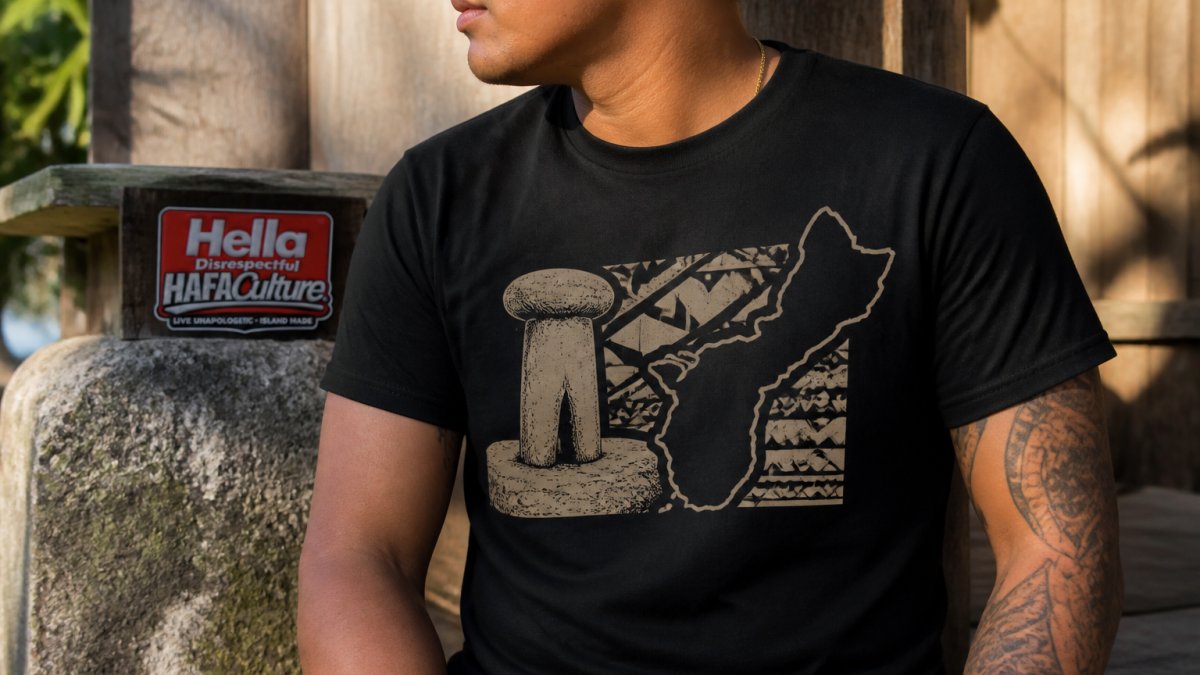
Chamorro patterns and symbols carry specific meaning, and the most recognizable is the latte stone. The latte stone is a pillar-and-capstone structure built by ancient CHamoru people, and it stands for strength, family, and the foundation of the home.
Other common motifs include:
- Island silhouettes and coastline shapes
- Traditional weaving and tattoo-inspired patterns
- The 671 area code as a marker of Guam identity
- Coordinates that tie a design to a specific place
These aren't random graphics. They're shorthand for heritage. When you wear them, you're carrying someone's history.
Intent vs. Impact: Why Good Intentions Aren't Enough
Good intentions don't cancel out impact. You can mean well and still cause harm, and that's the part a lot of people miss.
Here's the thing most guides get wrong: they tell you to just "be respectful" and move on. But respect isn't a feeling, it's an action. It shows up in where you buy, how you wear, and whether you listen when someone tells you it landed wrong.
If a CHamoru person says a design bothers them, that's information, not an attack. You don't have to agree with every opinion, but you do have to take it seriously. Impact is what the community feels, not what you intended.
Sacred vs. Everyday: What Not to Wear
Most Chamorro prints you see on shirts, stickers, and tote bags are everyday designs. A smaller set of imagery and objects is tied to ceremony, family, or spiritual practice, and that's where the line gets sharp.
Everyday designs are the ones CHamoru artists and brands produce for casual wear. They include:
- The latte stone used as a standalone graphic or logo mark
- Island silhouettes of Guåhan and the neighboring islands
- The 671 area code and Guåhan coordinates
- Modern tattoo-inspired linework created by contemporary CHamoru artists
- Slingstone and canoe motifs rendered as flat graphic prints
These are heritage shorthand. They're meant to be worn, shared, and recognized.
Sacred, ceremonial, or family-specific items are a different category. These include:
- Objects and imagery connected to specific CHamoru ceremonies and life events
- Patterns and motifs that belong to a particular family line or clan
- Weaving and body-marking traditions with spiritual or ancestral meaning
- Anything described by a CHamoru practitioner as restricted, initiated, or not for outsiders
- Replicas of actual ceremonial objects sold as novelty items
The rule is not complicated: if a design belongs to a ceremony, a ritual, a family, or an initiated practice, it is not streetwear. Don't wear it to a party. Don't turn it into a Halloween costume. Don't print it on a mug and sell it.
A few practical tests help here:
CHAMORRO ISLAND STRENGTH TEE →
- Can the seller tell you what the design is? If the answer is "it's just a tribal pattern" or "Polynesian style," that's a red flag. CHamoru design is not interchangeable with Hawaiian, Māori, Samoan, or Fijian design, and a brand that lumps them together usually hasn't done the work.
- Is the design attached to a person or a lineage? Family-specific motifs shouldn't be reproduced by strangers, even with good intentions.
- Is it being sold as a costume? Costume framing, grass skirts, fake tattoos, "island girl" packaging, is one of the clearest signals that a design has been turned into a stereotype.
- Does the item's purpose match the design's purpose? A ceremonial pattern on a beach towel is a mismatch. A latte stone on a t-shirt made by a CHamoru-owned brand is not.
Context also changes how a piece lands. The same shirt can read as everyday representation at a family gathering on island, as a thoughtful purchase at a CHamoru-owned pop-up, and as tourism costume at a resort gift shop. Occasion, setting, and who is wearing it all shape the reception.
How to Support Chamorro Artists and Buy Authentically
Buying from CHamoru artists and businesses is the single most effective way to wear with respect. Your money should go to the community that made the design, not to a mass producer copying it.
Here's a quick checklist we use when we source or design anything:
- Can I name the artist or brand behind this design?
- Does the brand have ties to the CHamoru community?
- Is the design explained, or just slapped on a shirt?
- Is it mass-produced with no credit, or made with intent?
- Does the price reflect real work, or a cheap copy?
If you can't answer these, don't buy it yet. Ask the seller where the design came from. A real brand will have an answer.
This is also where we put our own money where our mouth is. Our Guåhan Culture Tee features the latte stone, island silhouette, Guåhan coordinates, and the 671 area code, designed for Chamorros on-island and worldwide. Our Hafa Culture Puff Tee - Chamorro Edition leads with a puff-print CHAMORRO design on the back. And our CHAMORRO ISLAND STRENGTH TEE is part of the Island Strength Collection, built for people who want to represent their roots.


| What to Look For | Red Flag | Why It Matters |
|---|---|---|
| Named CHamoru artist or brand | No credit, no source | Credit respects the maker |
| Explained design meaning | Generic "tribal" label | Meaning prevents misuse |
| Community ties | No connection to Guam | Support stays in the culture |
| Made with intent | Mass-produced copy | Quality and respect go together |
| Fair price | Suspiciously cheap | Cheap usually means stolen work |
How to Respond If Someone Says Your Print Is Offensive
This is the section most articles skip, and it's the one that actually matters. Almost every guide tells you how to avoid offending people.
Step 1: Listen before you explain. The instinct to say "but I bought it from a CHamoru artist" or "but I meant well" is understandable and almost always the wrong first move.
Step 2: Separate the claim from the person. CHamoru people are not a monolith. Some will tell you a latte stone tee is fine for anyone to wear.
Step 3: Check the design against the source. Go back to where you bought it. Can you name the artist? Is the brand CHamoru-owned or CHamoru-connected?
Step 4: Decide, and be honest about why. There are three reasonable outcomes:
- Stop wearing it. If the design turns out to be sacred, family-specific, or copied from a CHamoru artist without credit, retire the item. You don't need to make a public announcement. Just stop.
- Keep wearing it, with context. If the design is everyday, the maker is identifiable, and the objection is about personal preference rather than a specific harm, you can keep wearing it, and you can explain where it came from when asked. That explanation should be short and factual, not defensive.
- Keep it but change how you wear it. Sometimes the issue is styling or occasion, not the garment. A print that's fine at a casual event may not be appropriate at a ceremony or a formal gathering.
Step 5: Apologize without over-apologizing. A simple "I didn't know that, thanks for telling me, I'll look into it" is enough.
Step 6: Change one thing. The point of the conversation isn't to win it. It's to leave with a better understanding of what you're wearing.
A final note on who gets to say what's offensive. The most useful voices here are CHamoru artists, cultural practitioners, and community members speaking for themselves, not outsiders summarizing on their behalf. If you want to go deeper, follow CHamoru creators, read what they publish about their own work, and let their explanations shape how you wear what you buy.
Frequently Asked Questions
Is it offensive to wear Chamorro prints if you are not Chamorro?
It depends on the print and how you wear it. Everyday designs like the latte stone or 671 area code on a shirt from a Chamorro-owned brand are generally fine if you understand the meaning. Sacred or ceremonial symbols should be avoided. The key is respect: know what the design represents, buy from authentic sources, and don't treat it as a costume.
What do Chamorro patterns and designs represent?
Chamorro patterns often feature the latte stone (a pillar symbolizing strength and ancestry), island silhouettes, the 671 area code, and traditional weaving motifs. These represent heritage, resilience, and connection to Guam. Wearing them respectfully means acknowledging that history, not just the aesthetic.
How can you tell whether a Chamorro-inspired print is culturally respectful?
Look for designs sold by Chamorro artists or brands with clear ties to the community. Respectful prints usually avoid sacred symbols, use accurate motifs, and come with context about their meaning. If a company mass-produces tribal prints without credit or cultural explanation, that's a red flag.
How can you support Chamorro artists and designers when buying clothing?
Buy directly from Chamorro-owned businesses like Hella Disrespectful Clothing, which offers Chamorro-themed tees such as the Guåhan Culture Tee and Hafa Culture Puff Tee. Share their work, ask about their creative process, and avoid knockoff brands that copy designs without permission.
What is the difference between cultural appreciation and appropriation in fashion?
Appreciation involves learning about a culture and honoring it, often by supporting artists from that culture. Appropriation takes elements without understanding or credit, often for profit or shock value. With Chamorro prints, appreciation means buying from Chamorro creators and knowing the story behind the design.
Wearing another culture's designs is a decision, not a default. If you want apparel that does the work for you, made with real intent, Hella Disrespectful Clothing builds culture-forward pieces like the Hafa Culture series and offers custom DTF printing for your own designs. We keep the quality high and the meaning intact, from heavyweight tees to bold full-back graphics. Get started with Hella Disrespectful Clothing and wear your roots, or your respect, out loud.