

Custom DTF Transfers for Small Businesses
Table of Contents
- What Are DTF Transfers and Why They Matter for Small Apparel Brands
- DTF Gang Sheet Pricing and How to Maximize Your Budget
- Best Heat Press Settings for DTF Transfers
- DTF vs Screen Print Transfers: Which Method Wins for Your Business
- How to Apply Custom DTF Transfers Without Mistakes
- Troubleshooting Common DTF Transfer Failures
- Scaling Your Small Business with DTF: From One-Offs to Bulk Orders
- Frequently Asked Questions
Last Updated: September 20, 2026
What Are DTF Transfers and Why They Matter for Small Apparel Brands
Custom DTF transfers are direct-to-film prints that transfer vibrant, detailed designs directly onto garments using heat and pressure. Unlike traditional screen printing, DTF technology allows small businesses to produce high-quality custom apparel without minimum order requirements, making it ideal for entrepreneurs testing designs, building brands, or fulfilling one-off orders.

The process works by printing your design onto a special film using water-based inks, applying adhesive powder, and then pressing the transfer onto fabric using a heat press. The result is a durable, full-color print that withstands multiple washes and maintains color vibrancy. For small business owners, this means you can start with a single shirt or scale to bulk orders without changing your workflow.
At Hella Disrespectful Clothing, we've seen firsthand how custom DTF transfers level the playing field for independent brands. You get professional-quality prints at accessible price points, with no pressure to order in massive quantities. Whether you're building a streetwear brand, creating limited-edition drops, or fulfilling custom orders for clients, DTF gives you control over your production timeline and inventory.
The real advantage here is flexibility. You can order a single print for as little as $2, or stack multiple designs on a gang sheet and save significantly. That's why small businesses are moving toward DTF, it matches how they actually operate.
DTF Gang Sheet Pricing and How to Maximize Your Budget
A DTF gang sheet is a single large sheet that holds multiple designs, stacked vertically. Instead of ordering each design separately, you consolidate them onto one sheet and split the cost across all designs. This is where the real savings happen for small businesses scaling production.
Hella Disrespectful Clothing's gang sheet pricing reflects what most small operations need: a 12.5" x 54" sheet runs $14, a 12.5" x 108" sheet is $22, a 12.5" x 162" sheet costs $40, and a 12.5" x 216" sheet is $52. For bulk operations, a 12.5" x 364" sheet is $65. The math is straightforward: more designs on one sheet means lower cost per design.
Here's where strategy matters. A single DTF transfer for a 10"-12" adult print costs $8. If you're ordering 10 designs, that's $80 for individual prints. On a gang sheet, you're paying $14-$22 total and cutting your cost per design to $1.40-$2.20. The savings compound when you're running multiple drops or fulfilling bulk client orders.

The catch is setup. You need to arrange your designs on the sheet efficiently, which means understanding your press dimensions and fabric sizes. A wasted inch on a gang sheet is money left on the table. Many small businesses either waste space through poor layout or pay for design services to optimize their sheets. Hella Disrespectful Clothing charges $10 for artwork setup and gang layout, which pays for itself after two orders.
Best Heat Press Settings for DTF Transfers
The success of your DTF transfer depends entirely on heat press settings. Get the temperature, pressure, and dwell time wrong, and your design either doesn't adhere properly or scorches the fabric. The standard settings work for most applications, but fabric type matters.
For cotton and cotton-blend apparel, use 340°F with medium-heavy pressure for 10-15 seconds. This is the baseline. Cotton absorbs heat evenly and holds adhesive powder effectively at this temperature. Polyester requires slightly lower heat, around 320°F, because polyester melts if you push it too hard. Dwell time stays the same: 10-15 seconds.
Blended fabrics (50/50 cotton-poly or 60/40) sit in the middle. Use 330°F with medium-heavy pressure for 12 seconds. The blend responds differently than pure cotton because the polyester component resists heat. Going too hot scorches the synthetic fibers and creates a waxy, plasticky feel. Too cool and the adhesive powder doesn't fully activate.
Pressure is where most people make mistakes. "Heavy pressure" doesn't mean crushing the shirt. It means consistent, firm contact across the entire transfer for the full dwell time. A heat press with uneven pressure creates hot spots and cold spots, parts of your design adhere while others peel. If your press isn't maintaining even pressure, you'll see edge lifting or spotty color.
One critical detail: cold peel versus hot peel. Cold peel means removing the film after the transfer cools to room temperature. Hot peel means removing it while still warm. DTF transfers work best with cold peel, wait 30 seconds after pressing, then peel the film away. Hot peeling can pull the adhesive off the fabric.
DTF vs Screen Print Transfers: Which Method Wins for Your Business
Screen printing and DTF transfers solve different problems. Screen printing excels at high-volume, single-color or limited-color designs where you're printing the same image on 100+ units. DTF transfers dominate when you need color complexity, design variation, or low minimum orders.
Screen printing requires a setup fee of $50-$150 per color separation, plus a minimum order of 12-24 units per design. Once you hit that minimum, the per-unit cost drops significantly. A single-color screen print on a bulk order costs $2-$4 per shirt. But if you're only printing 5 shirts with a complex, multi-color design, screen printing becomes prohibitively expensive.
DTF transfers have no setup fees and no minimums. A custom DTF transfer costs $2-$8 depending on size and placement. You can order one shirt or 100 without price penalties. For photorealistic designs, gradients, or detailed artwork, DTF is the only practical choice, screen printing can't reproduce that level of detail without halftoning, which looks inferior.
The durability question surfaces often. Screen-printed designs last longer than DTF transfers if both are applied correctly. A properly screen-printed shirt maintains color and integrity through 50+ washes. A DTF transfer typically holds strong for 30-40 washes before noticeable fading. For most small businesses and consumers, that's sufficient. If durability is critical, like for workwear or athletic apparel, screen printing wins.
Cost per unit flips based on volume. At 5 units, DTF is cheaper. At 50 units, screen printing is cheaper. At 500 units, screen printing is dramatically cheaper. The break-even point is roughly 30-40 units per design. Below that, DTF. Above that, screen printing makes financial sense.
How to Apply Custom DTF Transfers Without Mistakes
Applying a DTF transfer is straightforward if you follow the sequence. First, prepare your heat press and confirm even pressure across the platen. A misaligned press creates uneven adhesion.
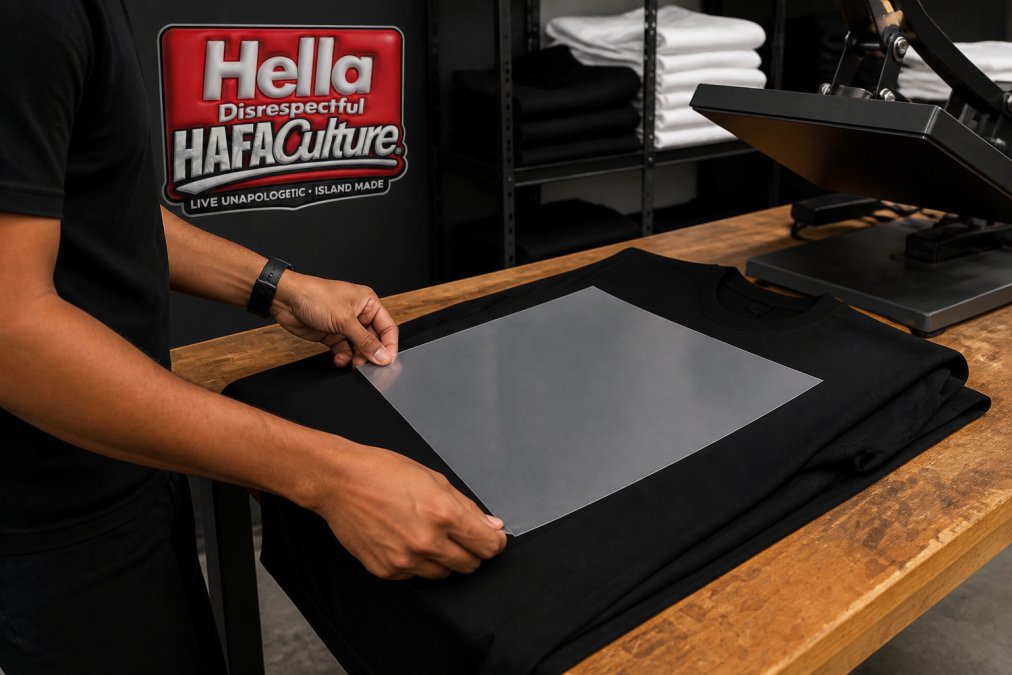
Second, place your garment on the lower platen. Smooth out wrinkles and creases, any bunching under the transfer creates voids and uneven pressure. Position the transfer where you want it. DTF transfers don't shift during pressing like some methods, but placement still matters for design impact.
Third, close the press and hold for your dwell time. Don't open and close repeatedly, that breaks the heat cycle and weakens adhesion. Consistency is everything. The adhesive powder needs sustained heat to fully activate and bond the ink to the fabric.
Fourth, open the press and let the transfer cool for 30 seconds on the garment. This cooling period is critical. The adhesive sets as it cools, creating a permanent bond. Peeling too early pulls the transfer away from the fabric.
Fifth, peel the film away in one smooth motion. Start at a corner and pull at a shallow angle, not straight up. A sharp, perpendicular peel can tear the design. If the transfer isn't peeling cleanly, it didn't cure long enough. Let it cool another 15 seconds and try again.
Common mistakes include insufficient pressure (design peels after one wash), too much heat (fabric scorches, design becomes brittle), and peeling too early (adhesive hasn't set, design lifts).
Troubleshooting Common DTF Transfer Failures
Design peeling after washing is the most frequent complaint. This happens when adhesion is incomplete, either pressure was too light, dwell time was too short, or the fabric wasn't smooth under the transfer.
Scaling Your Small Business with DTF: From One-Offs to Bulk Orders
Starting with single prints and scaling to gang sheets is the natural progression for small apparel businesses. A single DTF print at $2-$8 lets you test designs with minimal financial risk. Once a design proves popular, you move to gang sheets to reduce per-unit costs and increase profit margins.
| Growth Stage | Order Volume | Best Approach | Cost Per Transfer |
|---|---|---|---|
| Testing | 1-5 units | Single prints | $2-$8 |
| Early scaling | 5-20 units | Small gang sheets (12.5" x 54") | $1.40-$2.20 |
| Growth | 20-50 units | Medium gang sheets (12.5" x 108") | $1.10-$2.00 |
| Bulk production | 50+ units | Large gang sheets + outsourced pressing | $0.28-$1.50 |
Frequently Asked Questions
How much do custom DTF transfers cost for small batches?
Single DTF prints start at $2 for pocket-sized designs (3-5 inches) and go up to $8 for oversized 14-inch statement pieces. Gang sheets offer better value: a 12.5" x 54" sheet with multiple designs costs $14, while a 12.5" x 108" sheet runs $22. For small businesses testing designs or running limited drops, single prints let you avoid minimums, while gang sheets save money when you're stacking multiple designs on one sheet.
What are the main differences between DTF and screen print transfers?
DTF transfers handle high-detail artwork and full-color designs without setup fees. DTF prints vibrant colors directly onto the film with no minimums. DTF works on cotton, polyester, and blends. For small businesses and one-off custom orders, DTF offers faster turnaround and lower upfront costs.
Do I need a professional heat press for DTF transfers, or can I use a household iron?
If you don't have a heat press, Hella Disrespectful Clothing offers heat press application services ($5-$8) so you can skip the equipment investment entirely.
How long do DTF transfers last after washing?
Quality DTF transfers last through multiple washes when applied correctly. The adhesive powder cures into the fabric. Avoid high-heat dryers and bleach to extend the life of your prints.