

Is DTF Printing Good Quality? An Honest 2026 Review
Table of Contents
- How DTF Printing Actually Works
- What Makes DTF Print Quality Stand Out
- DTF vs DTG Printing Quality: Which Wins?
- How Long Do DTF Prints Last?
- DTF Printing Wash Instructions That Protect Your Prints
- Common DTF Quality Problems and How to Avoid Them
- The Verdict: Is DTF Printing Good Quality?
- Frequently Asked Questions
Last Updated: September 13, 2026
How DTF Printing Actually Works
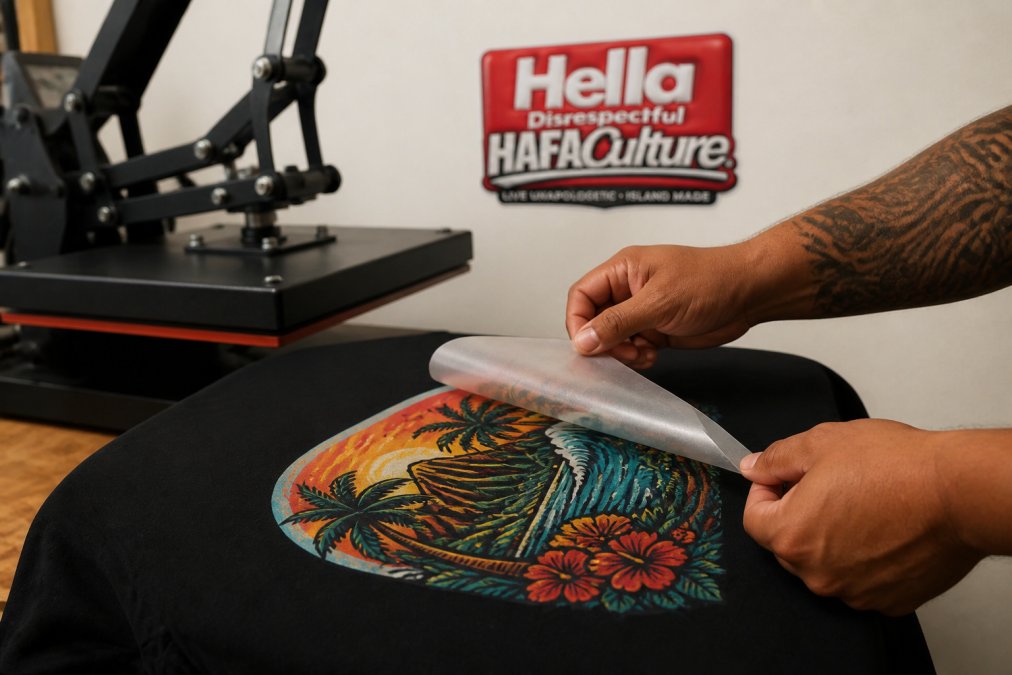
DTF printing, short for direct to film, is a garment decoration method where designs print onto a PET film, get coated in hot-melt adhesive powder, and transfer to fabric through a heat press. Hella Disrespectful Clothing offers custom DTF printing services, so we understand what separates a print that survives many washes from one that peels quickly.

The process moves through four stages:
- A printer lays pigment ink onto a PET film in reverse
- The wet print gets dusted with hot-melt adhesive powder
- A curing oven melts the powder into a flexible glue layer
- A heat press bonds the transfer to cotton, polyester, or blends
That adhesive layer is the whole trick. It sits between the ink and the fabric, which is why a DTF print stretches with a knit instead of cracking at the seams.
What Makes DTF Print Quality Stand Out
DTF print quality stands out because the ink sits on top of the adhesive film rather than soaking into the fabric, which keeps colors bright and detail intact. Two factors drive the final result: color vibrancy and how the print feels on the body.
Color vibrancy and print resolution
White ink sits underneath the color layer on DTF transfers, so a design keeps its opacity even on dark garments. That base layer is why a neon graphic looks the same on a black hoodie as it does on a white tee. Print resolution depends on the printer's DPI and the quality of the source file, so a low-resolution PNG will look soft no matter how good the transfer is. Photorealistic gradients and intricate line work both hold up well when the source art is clean.
Hand feel and stretchability
Hand feel is the single most subjective part of DTF, and it's where cheap transfers give themselves away. A correctly pressed DTF print has a slightly raised, rubbery texture compared to screen printing's flatter ink deposit. On stretchy fabrics, a good transfer flexes with the garment instead of cracking along a fold. Press it too hot or too long, though, and the adhesive over-cures, leaving a stiff, plastic-feeling patch.
DTF vs DTG Printing Quality: Which Wins?
DTF wins on color vibrancy and fabric versatility; DTG wins on hand feel for 100% cotton. That one-line answer is where most comparisons stop. The real difference lives in the ink chemistry, and once you understand it, the quality question answers itself.
The ink chemistry that drives every quality difference
DTG printers jet water-based ink directly into the fabric (screenprintingmag.com). The ink is absorbed into the cotton fibers, which is why a DTG print on a cotton tee feels like nothing is there, the color is literally inside the shirt. The tradeoff is mechanical: water-based ink needs a pretreatment spray to bond to synthetic fibers, and on polyester it produces muted, washed-out color because the ink can't anchor the way it does on cotton.
DTF uses pigment ink printed onto a PET film, then encapsulated by a hot-melt adhesive powder. The pigment particles sit in a plasticized layer that bonds to the fabric surface rather than soaking into it. That's why DTF holds saturated color on dark polyester without pretreatment, the white ink base layer blocks the garment color from showing through, and the adhesive carries the whole film onto the fabric in one transfer.
Where each method actually wins on quality
| Quality factor | DTF | DTG |
|---|---|---|
| Fabric compatibility | Cotton, polyester, blends, some nylon | Mostly 100% cotton; pretreated blends |
| Color on dark garments | Vibrant, no pretreatment | Muted, needs pretreatment |
| Hand feel | Slightly raised, rubbery | Very soft, near-zero |
| Fine detail and gradients | Holds well with clean source art | Holds well on cotton |
| Stretch recovery on knits | Flexes with the fabric | Can crack on high-stretch knits |
| Setup for small runs | No minimums | No minimums |
| Best for | Blends, poly, bold graphics, dark garments | Soft-hand cotton tees |
The hand-feel tradeoff, stated honestly
DTG's soft hand feel is its biggest quality advantage, and it's real. But softness isn't the same as durability. On high-stretch knits, think performance poly or a cotton-spandex blend, a DTG print can crack along stress points because the ink sits inside fibers that move independently. A DTF transfer's adhesive layer stretches as a single unit with the fabric, so it recovers from a fold instead of fracturing.
A properly cured DTF print can hold color longer because the pigment is sealed in the adhesive layer rather than exposed in the fiber.
How to pick based on what you're printing
- 100% cotton tees, soft hand feel is the priority: DTG is worth testing.
- Polyester, blends, or dark garments: DTF is the more reliable choice.
- High-stretch performance wear: DTF, because the adhesive layer moves with the fabric.
- Photorealistic gradients on cotton: both can do it; DTG edges out on softness, DTF edges out on color saturation.
- Mixed-fabric product line: DTF, because one transfer works across your whole catalog.
How Long Do DTF Prints Last?
A properly cured and pressed DTF print can last many washes when you follow the care instructions. Longevity comes down to three variables: how well the transfer was cured, how it was pressed onto the garment, and how the finished shirt is washed. Get all three right and the print can outlast the shirt.
The cure mechanics behind a durable print
The hot-melt adhesive powder is the load-bearing layer (PubMed). During curing, the powder melts and cross-links into a flexible glue film that bonds the pigment layer to the fabric. Under-cured powder never fully melts, so the adhesive stays granular and lifts at the edges on the first wash. Over-cured powder becomes brittle, so the print cracks along stress points instead of flexing.
The press stage is a second cure event. The heat press re-melts the adhesive to bond it to the garment. Press too cool and the bond is weak; press too hot or too long and you cook the adhesive past its flexible range. The window is narrow, which is why a single test shirt before a batch run catches more problems than any spec sheet.
The four failure modes and what each one means
| Failure | What it looks like | Root cause |
|---|---|---|
| Cracking | Fine lines along folds and stress points | Over-pressed or over-cured adhesive |
| Peeling | Edges lift, print separates from fabric | Under-cured powder or cool press |
| Fading | Color dulls, especially on dark garments | Hot washes, harsh detergent, bleach |
| Dull color | Print looks flat from day one | Low-resolution source file or wrong ink profile |
The pattern is consistent: heat and file quality cause almost every failure. A common mistake is blaming the transfer when the real problem is a press running too hot or a design exported at 72 DPI.
Shelf life and storage: the question most guides skip
Pre-printed DTF transfers have a shelf life, and it's shorter than most people assume. The adhesive powder is hygroscopic, it absorbs moisture from the air, and heat accelerates the degradation (PubMed). A transfer stored in a hot car or a humid room can lose its bond strength before it ever touches a shirt.
Storage rules that actually matter:
- Keep sheets flat. Curled or folded transfers press unevenly and leave cold spots where the adhesive never fully bonds.
- Keep them cool and dry. A climate-controlled room extends usable shelf life; a garage or attic shortens it.
- Keep them out of sunlight. UV exposure degrades the pigment layer over time.
- Use them in rotation. Older transfers first, so nothing sits long enough to degrade.
- Seal opened packs. A zip bag or airtight container slows moisture absorption.
If you're buying in bulk, proper storage helps protect the quality of your transfers.
What '50 washes' actually means
DTF longevity is operator-dependent, not method-dependent, the same transfer can last a long time or a short time depending on who pressed it and how the customer washes it.
DTF Printing Wash Instructions That Protect Your Prints
Wash DTF-printed garments inside out in cold water and tumble dry on low, and the print will outlast the shirt. Heat is the enemy of any heat transfer, so every rule here comes back to keeping the press bond intact.
- Turn the garment inside out before washing
- Use cold water on a gentle cycle
- Skip fabric softener and bleach
- Tumble dry low or hang to dry
- Avoid ironing directly over the print
- Wait 24 hours after pressing before the first wash
Following these steps is the difference between a print that looks new after a year and one that fades in a month. If a customer complains about a DTF print failing early, the wash routine is the first thing to check.
Common DTF Quality Problems and How to Avoid Them
Most DTF quality complaints trace back to four fixable issues: cracking, peeling, fading, and dull color. None of them mean the method is bad; they mean a step in the process was off.
| Problem | Likely Cause | Fix |
|---|---|---|
| Cracking | Over-pressed or over-cured | Lower press temp, shorten dwell time |
| Peeling | Under-cured powder | Re-check curing oven settings |
| Fading | Hot washes, harsh detergent | Cold wash, inside out, no bleach |
| Dull color | Low-res source file | Use a high-quality PNG |
The pattern is consistent: heat and file quality cause almost every failure. A common mistake is blaming the transfer when the real problem is a press running too hot or a design exported at 72 DPI. Test one shirt before running a batch, and you'll catch the issue before it costs you a full order.
The Verdict: Is DTF Printing Good Quality?
Yes, DTF printing is good quality when it's done right, offering color vibrancy, fabric versatility, and suitability for small batch production. The catch is that "done right" depends entirely on the operator. A well-cured transfer pressed at the correct temperature produces a print that can survive many washes with color intact. A rushed job can produce peeling or cracking.
So the honest answer to whether DTF is good quality is: it depends on who's printing it. The method itself is proven. The variable is the shop behind the press. For brands and creators who need vibrant, durable prints without minimums, DTF is one of the most flexible options available today.
Frequently Asked Questions
Does DTF printing feel like plastic on the shirt?
A properly applied DTF print has a soft, flexible hand feel that moves with the fabric. It does not feel like a thick plastic layer. The hot-melt adhesive powder and thin film transfer create a smooth surface that sits close to the garment. Cheaper DTF prints or those applied with too much heat and pressure can feel stiffer, but quality transfers from a reputable provider feel comfortable and stretch with the shirt.
How long do DTF prints last?
DTF prints can last many washes when cared for properly. The key factors are application temperature, pressure, and following the right wash instructions. Wash inside out in cold water, avoid fabric softener, and tumble dry low or hang dry. Prints that peel or crack early usually result from poor application or harsh washing, not from the DTF method itself.
Is DTF printing good quality compared to DTG?
DTF can produce vibrant colors and works on various fabric types, including cotton, polyester, and blends. DTG excels on 100% cotton with a softer feel but can look muted on dark or synthetic fabrics. For intricate designs, small batch production, and fabric versatility, DTF is a strong choice for quality and consistency.
Which is better for custom apparel, DTF or screen printing?
DTF is suitable for small batch production, detailed artwork, and orders with no minimums. DTF also handles photorealistic and multi-color designs without the setup costs screen printing requires. For one-off pieces or small drops, DTF offers quality and flexibility.
How many washes can a DTF print last?
Most quality DTF prints can survive many washes if you follow proper care instructions. Wash the garment inside out in cold water with mild detergent, skip fabric softener, and avoid high heat in the dryer. Following these steps protects the adhesive bond and keeps colors vibrant. Prints that fail early usually trace back to incorrect heat press settings or rough washing habits.
Bold graphics and durable prints shouldn't be a gamble. Hella Disrespectful Clothing runs a full DTF lab with vibrant, high-resolution transfers, no minimums, and fast turnaround, plus heat press application and rush service if you'd rather skip the equipment entirely. Whether you're testing one design or pressing a full drop, we handle the printing so you can focus on the brand. Get started with Hella Disrespectful Clothing and press prints that actually hold up.