

How to Learn Basic Chamorro Language Fast
Last Updated: October 26, 2026
Quick Summary
To learn how to learn basic Chamorro language fast, start with pronunciation by drilling the six vowels and the consonants that differ from English, then practice common phrases out loud daily. Build a routine of about ten minutes a day using Anki for vocabulary, one YouTube channel for listening, and a weekly conversation partner.
- Say each vowel out loud five times before moving on, especially the å.
- Practice daily, even for ten minutes, because consistency beats marathon sessions.
- Use Anki for vocabulary and a separate resource for listening rather than one app.
- A weekly conversation with a fluent speaker beats any app.
- Follow a 30-day plan moving from vowels to greetings, sentences, and conversation.
Table of Contents
- Start With Pronunciation: The Sounds You Need First
- Common Chamorro Phrases for Daily Conversation
- The Meaning of Hafa Adai and Why It Matters
- How Long Does It Take to Learn Chamorro?
- Best Chamorro Language Learning Apps and Tools
- Build a 30-Day Chamorro Practice Routine
- Mistakes That Slow Down Beginners Learning Chamorro
- Wear Your Progress: Shop the Hafa Culture Collection
- Frequently Asked Questions
Start With Pronunciation: The Sounds You Need First
Chamorro pronunciation is more forgiving than it looks, but only if you build the sounds in the right order. This guide on how to learn basic Chamorro language walks you through each sound with a physical mechanism, an English anchor word, and a five-minute drill, the difference between reading about pronunciation and actually producing it.
Step 1: The Six Vowels
| Letter | English anchor | Mouth position | Example word |
|---|---|---|---|
| a | "father" | Open, tongue low and forward | håfa (what) |
| e | "bet" | Mid, tongue forward | bet (no direct English cognate; short e) |
| i | "machine" (short) | High, tongue forward | si (subject marker) |
| o | "more" (rounded) | Mid-back, lips rounded | hågu (you) |
| u | "flute" (short) | High-back, lips rounded | hulo' (up) |
| å | "saw" | Open, tongue low and back, lips unrounded | håfa (what) |
Step 2: Consonants That Differ From English
Drill: Say "sing" and hold the final ng. Now start a word with that same hum: ng-nga-nga. Repeat ten times. Then practice the glottal stop by saying "uh-oh" five times and noticing where your throat closes.
Step 3: Stress and Accent Marks
Drill: Read håfa adai five times, clapping on the stressed syllables. Then read it without clapping, keeping the same rhythm.
Step 4: Put It Together
A common mistake is rushing past the å because it feels awkward. Slow down: say each vowel out loud five times before moving on. The å is the sound that makes the rest of the language click.
Common Chamorro Phrases for Daily Conversation
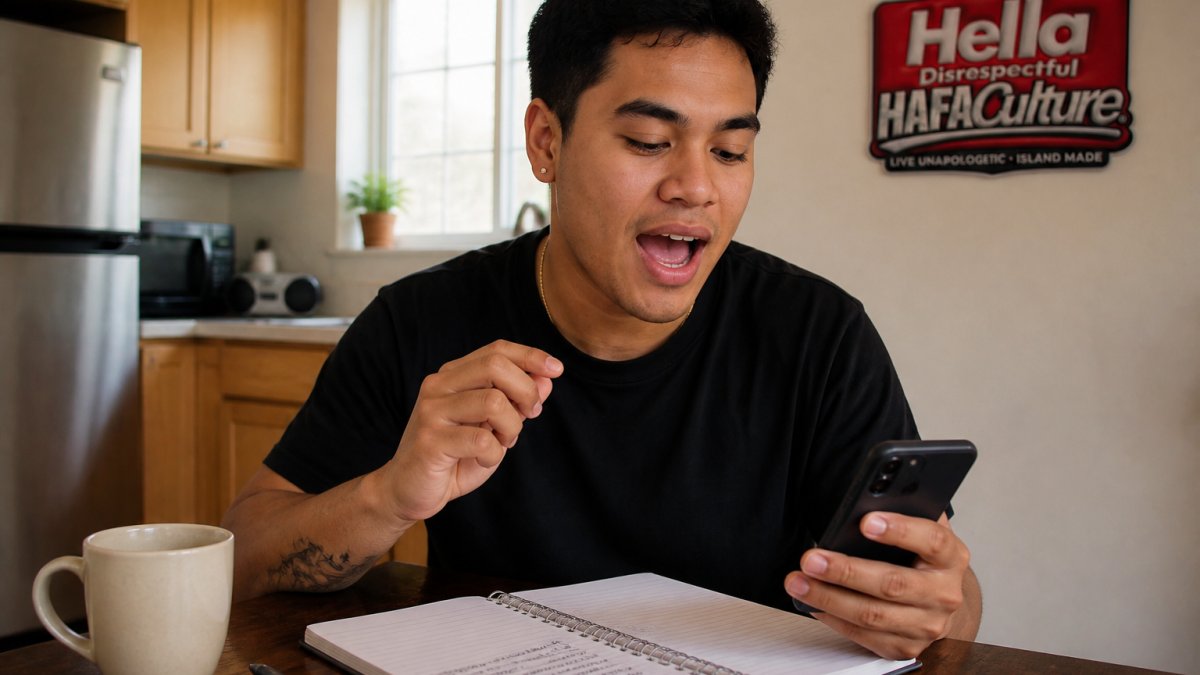
Say each one out loud. Then use it the same day, even if it's just to yourself. Verbal communication sticks when your mouth has already made the shape.
The Meaning of Hafa Adai and Why It Matters
Learning the phrase is easy. Understanding why it matters is what makes you sound like you mean it. Where America's Day Begins: Guam Explained covers the island where the culture comes from.
How Long Does It Take to Learn Chamorro?
Practice daily, even for ten minutes. Consistency beats marathon sessions every time.
Best Chamorro Language Learning Apps and Tools
No single app teaches Chamorro well on its own. The best approach mixes digital tools, community contact, and repetition. Here's a concrete stack, with what each tool does and where it falls short.
Language Apps
A common pattern is to use Anki for vocabulary and a separate resource for listening. Don't expect one app to do both.
CHAMORRO ISLAND STRENGTH TEE →
Online Dictionaries and Grammar Resources
- The Chamorro-English Dictionary (University of Hawaii Press) is the standard print reference; used copies are widely available. For online lookups, the Chamorro dictionary at chamoru.info is a commonly used community resource, though coverage is uneven for technical vocabulary.
- University of Guam and University of Hawaii language programs publish free grammar sketches and lesson PDFs. These are written for linguists, so expect terminology, but they're the most accurate free grammar source.
- Glosbe and Wiktionary have Chamorro entries with example sentences; useful for cross-checking a word's usage, not for learning structure.
YouTube and Social Media
Search YouTube for "Chamorro language lesson" and you'll find a small but growing set of channels run by heritage speakers. Quality is inconsistent, so watch a full video before committing; the advantage is hearing native pronunciation, the closest thing to a free tutor. Social media heritage-language pages post short phrase videos and pronunciation clips, good for daily exposure, not structured study.
Community and Immersion
This is where real progress happens. Local Chamorro cultural groups, heritage organizations, and family elders are the best language teachers you'll find. Listen to oral tradition, songs, and recorded speech, a weekly conversation with a fluent speaker beats any app.
A Practical Starter Stack
If you want a concrete setup today: Anki for vocabulary (10 minutes daily), one YouTube channel for listening (5 minutes), and one conversation partner (weekly). Add a dictionary bookmark for lookups. That's the whole stack, everything else is optional.
Build a 30-Day Chamorro Practice Routine
| Week | Focus | Daily Practice | Goal by Week's End |
|---|---|---|---|
| Week 1 | Pronunciation and vowels | 10 min vowel drills, 5 min listening | Say the six vowels cleanly |
| Week 2 | Greetings and phrases | 10 phrases, spoken out loud | Use Håfa Adai naturally |
| Week 3 | Sentence structure | Build 5 simple sentences daily | Ask and answer basic questions |
| Week 4 | Conversation practice | Chat with a speaker or record yourself | Hold a short back-and-forth |
Mistakes That Slow Down Beginners Learning Chamorro
One more thing: learning Chamorro as an outsider comes with responsibility. The language belongs to a community, and approaching it with respect matters. Our guide on honoring Pacific Islander heritage covers the mindset.
Wear Your Progress: Shop the Hafa Culture Collection
Our Hafa Culture series includes apparel inspired by Chamorro culture.
The Guåhan Culture Tee and Håfa Culture Tee are each $25.00.
The Guåhan Culture Tee features a latte stone and island silhouette, and the Hafa Culture Puff Tee features a puff-print “CHAMORRO” design on the back. Both are $25.00. SHOP THE DROPS.
Frequently Asked Questions
What are some common Chamorro phrases for beginners?
Start with greetings and everyday courtesy: Hafa Adai (hello), Buenas (good morning/afternoon), Maolek (good/fine), Si Yu'us Ma'åse' (thank you), and Åsta luego (see you later). Add Buenas noches for good evening and Dispensa yo' for excuse me. Practice five phrases out loud daily for a week before adding new ones. Saying them aloud builds the muscle memory that reading alone never gives you.
What is the meaning of Hafa Adai?
Hafa Adai is the traditional Chamorro greeting, roughly translating to hello or how are you. It carries more weight than a casual hi: it signals respect, hospitality, and connection to Chamorro cultural heritage. You will hear it across the Mariana Islands and in Chamorro communities in the United States. Using it correctly, with a warm tone, shows you understand the culture behind the words, not just the vocabulary.
How long does it take to learn Chamorro?
Expect roughly three to six months of consistent practice to hold basic conversation, and one to two years for fluency. Twenty minutes daily beats a three-hour weekend session because language acquisition rewards repetition. Focus first on pronunciation and the 200 most common words, then add sentence structure. Immersion through Chamorro speakers, oral tradition recordings, and daily conversation accelerates the timeline significantly.
What are the best Chamorro language learning apps?
No single app teaches Chamorro thoroughly, so combine tools. General platforms like Duolingo and Memrise offer user-created Chamorro decks for basic vocabulary. Drops works well for visual word drills. For pronunciation and cultural context, pair apps with YouTube lessons from Chamorro educators and community language resources. Use apps for daily repetition and save live conversation practice with native speakers for weekends.
