

Is Custom DTF Printing Worth It in 2026?
Table of Contents
- The Verdict: When Custom DTF Printing Pays Off
- DTF vs DTG Printing: Which Method Fits Your Workflow
- DTF Transfer Durability: How Long Prints Actually Last
- The Real Cost of DTF Printing for Small Business
- The Hidden Costs Nobody Talks About
- Software and File Prep: What You Need to Know
- Conclusion: Is Custom DTF Printing Worth It for You?
- Frequently Asked Questions
Last Updated: September 11, 2026
The Verdict: When Custom DTF Printing Pays Off
Custom DTF printing is worth it when you need small batches of vibrant, full-color designs on cotton, polyester, or blends without paying setup fees or meeting minimum order quantities. For most small brands and creators, the math favors it. For high-volume single-design runs, it usually doesn't.
Here's the honest version: DTF pays off when flexibility matters more than unit cost. If you're printing 500 identical black tees, screen printing still wins on price. If you're printing 15 tees across 6 designs, DTF is the only method that makes sense. That gap is where most people get the decision wrong.
At Hella Disrespectful Clothing, we offer custom DTF printing services specifically because that middle ground, small batches, multiple designs, no minimums, is where the method earns its keep. The 5 factors below decide whether it works for you.

U.S. Small Business Administration guidance on starting a business
DTF vs DTG Printing: Which Method Fits Your Workflow
DTG printing jets ink directly onto a garment, while DTF prints your design onto a transfer film that gets heat-pressed onto the fabric. That single difference drives everything else.
DTG works best on 100% cotton. On polyester and blends, DTG inks can struggle to bond, and colors sometimes look washed out. DTF sidesteps that entirely. Because the design sits on a transfer film with a hot melt powder adhesive layer, it bonds to cotton, polyester, blends, and even nylon. Fabric compatibility is the biggest practical gap between the two.
The tradeoff is workflow. DTG is a one-step process: load the shirt, print, cure. DTF adds steps, printing the film, applying powder, curing, then pressing. For a shop doing one-off prints, DTG is faster. For a shop running multiple designs on mixed fabrics, DTF is more versatile.
| Factor | DTF | DTG |
|---|---|---|
| Fabric range | Cotton, polyester, blends, nylon | Mostly 100% cotton |
| Setup per design | Print film, powder, cure, press | Print directly, cure |
| Small batch friendly | Yes | Yes |
| Color vibrancy on dark shirts | High, with white ink base | Variable |
| Best for | Mixed fabrics, bold graphics | Cotton-only, single-step output |
DTF Transfer Durability: How Long Prints Actually Last
A properly applied DTF transfer typically lasts 50 or more washes when pressed correctly, and it can hold up longer on quality garments. The failure point is almost never the print itself. It's the application.
Three things decide whether your DTF transfer survives:
- Press temperature and pressure. Too cool or too light, and the adhesive never fully bonds. The print lifts at the edges first.
- Curing. Under-cured film means the powder doesn't fully melt into the ink layer, which weakens wash durability.
- Fabric prep. Lint, moisture, or wrinkles under the transfer create weak spots.
Wash durability also depends on how the customer cares for the garment. Cold water, inside-out, no dryer heat, and the print outlasts the shirt. Hot water and high heat break down any heat transfer over time.
American Cleaning Institute guidance on fabric care
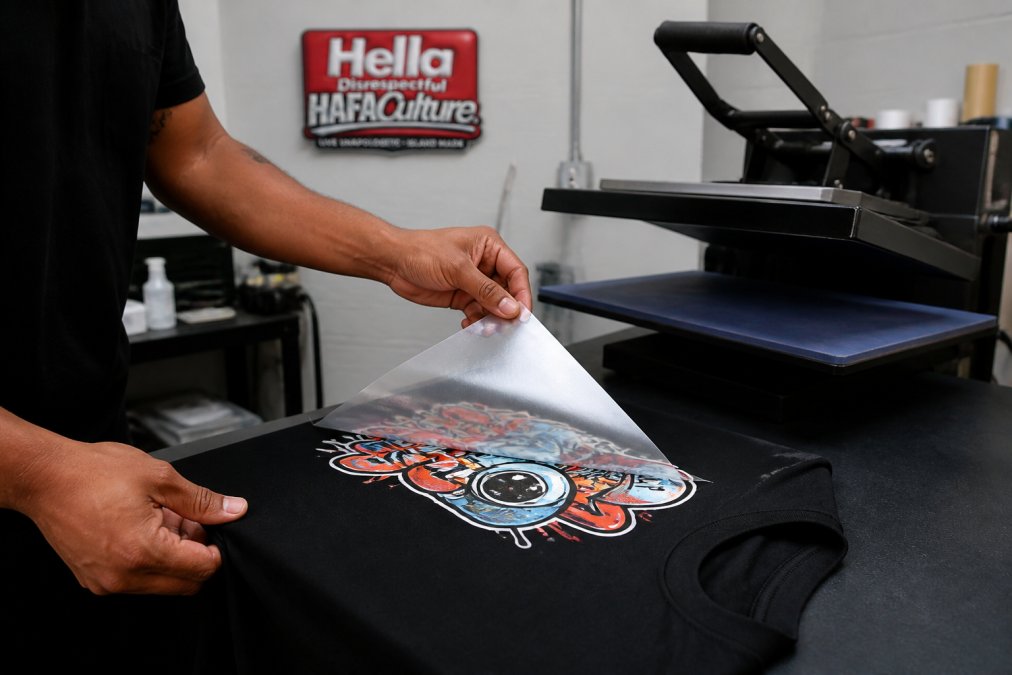
The customer question we hear most is whether prints crack or peel after a few washes. The answer is that a correctly pressed DTF transfer doesn't crack the way cheap vinyl does, because the ink layer flexes with the fabric instead of sitting rigid on top of it.
The Real Cost of DTF Printing for Small Business
The cost of DTF printing for a small business splits into two models: buying your own equipment or outsourcing transfers. Outsourcing wins for almost everyone starting out, but the reason is a break-even calculation, not a slogan. Here is the math most guides skip.

DIY setup: the upfront stack. A desktop DTF printer sized for apparel runs in the low-to-mid four figures. Add a curing oven or shaker, a heat press, an initial ink load, film, hot melt powder, and RIP software, and the realistic all-in startup lands well above the printer's sticker price. That capital sits idle until you sell enough shirts to amortize it.
DIY setup: the ongoing stack. Every print consumes ink, film, and powder. White ink is the expensive channel and the one that clogs. Then layer on:
- Daily nozzle checks and white ink circulation
- Periodic ink system flushes and waste ink pads
- Printhead replacement when a clog goes untreated
- Electricity for the curing oven on every run
- RIP software license or subscription
A single printhead replacement can cost more than a full year of outsourced transfers at hobbyist volume. That is the number that flips the decision.
Outsourcing: the per-unit stack. You pay per transfer and skip every line above. Single DTF prints start at $2.00 per design, and gang sheets that stack multiple designs onto one film start at $14.00. A 10-design test drop on gang sheets costs less than one month of DIY consumables.
The break-even question. Divide your total DIY startup plus 12 months of estimated consumables and maintenance by your outsourced per-transfer price. The result is the number of transfers you must sell in year one just to match outsourcing. Most small brands never reach it, because their design count outpaces their per-design volume.
| Cost line | DIY ownership | Outsourced transfers |
|---|---|---|
| Upfront equipment | High, four figures | $0 |
| Per-transfer material | Ink, film, powder | Included in price |
| Maintenance | Printheads, flushes, pads | $0 |
| Software | RIP license required | None |
| Time per job | Print, powder, cure, press | Upload and press |
| Break-even | High volume, few designs | Low volume, many designs |
The Hidden Costs Nobody Talks About
The sticker price of a DTF printer is the smallest number in the equation. What most guides leave out is everything after it, and this is the section competitors skip entirely. Here is the ownership cost model nobody publishes.
1. Long-term maintenance, itemized. Printheads are a wear item, not a one-time purchase. Ink systems need periodic flushing. Waste ink pads fill and must be replaced. Curing ovens draw power on every run. Most practitioners find that annual maintenance on a desktop DTF printer runs a meaningful fraction of the printer's original price, and that number grows the more you print. A neglected printhead is the single largest surprise expense.
2. Ink waste and misfires. White ink recirculation, nozzle checks, and cleaning cycles consume ink you never sell. Add failed presses, misaligned films, and test prints, and the true cost per sellable transfer is higher than the material cost per printed transfer. That gap is invisible until you track it.
3. Software and color management. A RIP software license handles color management, white ink layering, and gang sheet layout. It is a required purchase for DIY, not optional, and it carries a learning curve measured in hours before your first sellable sheet.
4. The learning curve itself. Wasted film, failed presses, and test prints that never sell are real costs. A new owner typically burns through a meaningful amount of film and powder before dialing in temperature, pressure, and cure time.
5. Environmental impact. DTF uses plastic-based transfer film and hot melt powder. Spent film, misfires, and waste ink become solid waste. Outsourcing concentrates that waste at one facility with better handling and disposal, while a home setup sends it straight to the trash. If sustainability matters to your brand story, this is a real trade-off, and one no competitor addresses.
6. Workflow integration. Every hour spent troubleshooting a printer is an hour not spent selling. If you already run screen printing, DTF can slot in as a complement for short runs and multi-color jobs, but only if you build the handoff into your workflow. Otherwise it becomes a second job.
| Hidden cost | DIY ownership | Outsourced transfers |
|---|---|---|
| Printhead replacement | Recurring, unpredictable | $0 |
| Ink waste from cleaning | Ongoing | $0 |
| RIP software | Required license | None |
| Learning curve waste | Film, powder, time | Minimal |
| Environmental disposal | Home trash stream | Concentrated facility |
| Workflow overhead | Hours per week | Upload and press |
Software and File Prep: What You Need to Know
File prep decides print quality more than the printer does. Send a bad file and no machine saves it.
For DTF, you need a high-resolution PNG with a transparent background. Standard print resolution is 300 DPI at final print size. If your design is sized for a 10-inch print, build it at 3000 pixels wide. Undersized files print soft and pixelated, and no amount of white ink hides that.
RIP software handles the rest: color management, white ink layering, and gang sheet layout. If you're outsourcing, RIP work happens on the printer's end, so your job is just uploading a clean, correctly sized file. If you're running your own printer, RIP software is a required purchase, not optional.
Three file-prep rules that prevent most reprints:
- Build at final size at 300 DPI, not upscaled after the fact
- Use a transparent background, not a white box behind the design
- Flatten text and check that thin lines survive at print size
Adobe guidance on print resolution and file preparation
Conclusion: Is Custom DTF Printing Worth It for You?
The answer comes down to volume and variety. If you're printing small batches, mixing fabrics, and changing designs often, custom DTF printing is worth it, and outsourcing makes it affordable from day one. If you're printing one design in the hundreds, screen printing still wins.
The smarter move for most small brands is to outsource transfers first, prove the designs sell, then decide whether equipment ever makes sense. Hella Disrespectful Clothing offers custom DTF printing services with no minimums, vibrant prints, fast turnaround, and add-on services like rush turnaround when you need it. Start with a gang sheet, press your first drop, and let the sales tell you whether to scale.

Frequently Asked Questions
What are the disadvantages of DTF printing?
DTF printing requires investment in equipment, materials, and ongoing maintenance. Startup costs can run several thousand dollars for a printer, curing oven, and heat press. The process demands careful printhead maintenance, white ink circulation, and proper curing to avoid cracked or faded transfers. For very large runs, screen printing often costs less per unit. However, DTF offers no minimums, works on many fabrics, and suits small batches, making it a strong fit for startups and custom apparel brands.
How much should a DTF print cost?
DTF print pricing depends on size and quantity. Single prints range from $2 for small pocket designs up to $8 for oversized 14-inch statement pieces. Gang sheets offer better value for multiple designs: a 12.5 by 54-inch sheet runs $14, while larger sheets scale up to $65 for 12.5 by 364 inches. Add-on services like rush turnaround, heat press application, or artwork setup cost extra. For small businesses, gang sheets typically deliver the lowest cost per design.
How long do DTF transfers typically last?
DTF transfer durability depends on application and care. When pressed correctly with proper heat, pressure, and time, DTF prints withstand 50 or more washes without significant fading or cracking. The hot melt powder and transfer film bond well to cotton, polyester, and blends. To maximize lifespan, wash garments inside out in cold water and avoid high-heat drying. Poor curing or low-quality transfers are the main reasons DTF prints fail early.
Is DTF printing better for small batches or large production runs?
DTF printing excels for small batches and one-off designs because it requires no minimums and no setup screens. A single print or gang sheet lets you test designs without committing to hundreds of units. For large production runs, screen printing usually wins on cost per unit. However, DTF remains competitive for medium runs and complex multicolor designs where screen printing setup costs add up. Small businesses often use DTF for samples and limited drops, then switch to screen printing for bulk orders.
What equipment is required to start a professional DTF printing operation?
A professional DTF setup typically includes a DTF printer, hot melt powder shaker, curing oven, and heat press. You also need transfer film, DTF ink, and RIP software for color management. Startup capital can range from a few thousand dollars for entry-level equipment to over $10,000 for higher-volume systems. Maintenance supplies like cleaning cartridges and printhead wipes add ongoing costs. Many small businesses start by outsourcing transfers to a service before investing in their own equipment.
The real challenge isn't picking a printing method. It's proving your designs sell before you sink money into equipment. Hella Disrespectful Clothing takes that risk off the table with custom DTF printing that has no minimums, gang sheets starting at $14.00, single prints from $2.00, and optional heat press application so your pieces arrive ready to wear. Get started with Hella Disrespectful Clothing and press your first drop without buying a single machine.