

Durable Custom Clothing for Brand Owners: A 2026 Guide
Table of Contents
- What Makes Durable Custom Clothing Worth the Investment
- Custom Apparel Manufacturing for Brands: Production Models That Scale
- Custom DTF Printing: Durability and Quality Standards
- Custom Clothing Manufacturers: Evaluating Fabric Quality and Construction
- Custom Heat Transfers: Application Methods and Longevity
- Total Cost and Unit Economics: Building Your Brand Without Overproduction
- Decision Framework: Choosing the Right Production Model for Your Brand
- Frequently Asked Questions
Last Updated: October 17, 2026
What Makes Durable Custom Clothing Worth the Investment
Building a brand means your apparel has to work harder than off-the-shelf alternatives. Durable custom clothing for brand owners isn't just about looking good, it's about lasting through real wear, multiple washes, and the kind of handling that separates cheap merch from pieces people actually keep.
Here's what separates durable custom apparel from the rest: construction quality, fabric weight, and printing durability. When you're printing logos or designs on garments, you're not just buying blank apparel, you're investing in a production model that either protects your brand or undermines it.
At Hella Disrespectful Clothing, we've built our custom DTF printing service around this reality. Direct-to-film transfers don't crack, fade, or peel the way older printing methods do. But durability goes beyond the printing technique. It starts with the garment itself.

When you're sourcing custom apparel for your brand, you're making a choice between two production models: on-demand printing for smaller runs, or bulk manufacturing for scale. Each has real tradeoffs in cost, durability, and control.
Custom Apparel Manufacturing for Brands: Production Models That Scale
On-Demand Production vs. Bulk Manufacturing
The production model you choose determines everything: your minimum order quantity, unit cost, turnaround time, and how much inventory risk you carry.
On-demand production means you print and ship individual orders as they come in. No inventory sitting in a warehouse. No guessing wrong on color or size mix. You pay per unit, and you only make what sells.
On-demand wins on flexibility and cash flow. You're not locked into a SKU mix you can't move. Bulk manufacturing wins on per-unit cost. Order 500 hoodies and your unit price drops significantly compared to printing 50 one at a time.
The real question isn't which is better, it's which fits your business model. If you're testing designs, validating demand, or running seasonal drops, on-demand printing keeps you lean.

Minimum Order Quantities and Order Flexibility
Minimum order quantities (MOQs) define whether a production model is actually accessible to you.
On-demand services typically have no minimums, you can order a single shirt or a gang sheet with multiple designs. Hella Disrespectful Clothing's Single DTF Prints service starts at a single 3-inch pocket print for $2.00. You're not forced to buy in bulk just to get started.
Bulk manufacturers usually require minimums of 100-500 units per style. Some negotiate lower MOQs for established partners, but you're still committing to real volume upfront.
Order flexibility matters more than most brands realize. Can you reorder fast if a design sells out? Can you adjust colors mid-season? Can you test a new print placement without ordering 200 units? On-demand printing gives you that flexibility. Bulk manufacturing trades flexibility for per-unit savings.
Custom DTF Printing: Durability and Quality Standards
How DTF Transfers Perform Through Washing and Wear
DTF (Direct-to-Film) printing is a different beast from screen printing or traditional heat transfers. The ink sits on a film layer that gets transferred to the garment under heat and pressure. This matters for durability.
The transfer doesn't crack because the ink isn't sitting on the surface of the fabric, it's bonded into the fibers. The film itself is engineered to flex with the fabric, which is why it survives repeated stretching and movement.
What kills DTF prints is low-quality film, inadequate heat application, or pressing onto cheap garments. If the blank tee is thin and fragile, even a perfect DTF transfer will fail because the garment itself is failing. The printing method is only as durable as the garment underneath it.
Design Clarity and Color Retention
You're not limited to 4-6 colors like traditional screen printing. You can print photographic detail, gradients, and intricate artwork without color separation headaches.
The color stays vibrant through washing because the ink is sealed into the film before it hits the garment. Reds stay red. Blues stay blue. Blacks stay black.
The trade-off is detail. DTF printing gives you photorealistic clarity, but it requires high-resolution artwork. If your design is low-res or pixelated, DTF will make that obvious. You need clean artwork going in.
Custom Clothing Manufacturers: Evaluating Fabric Quality and Construction
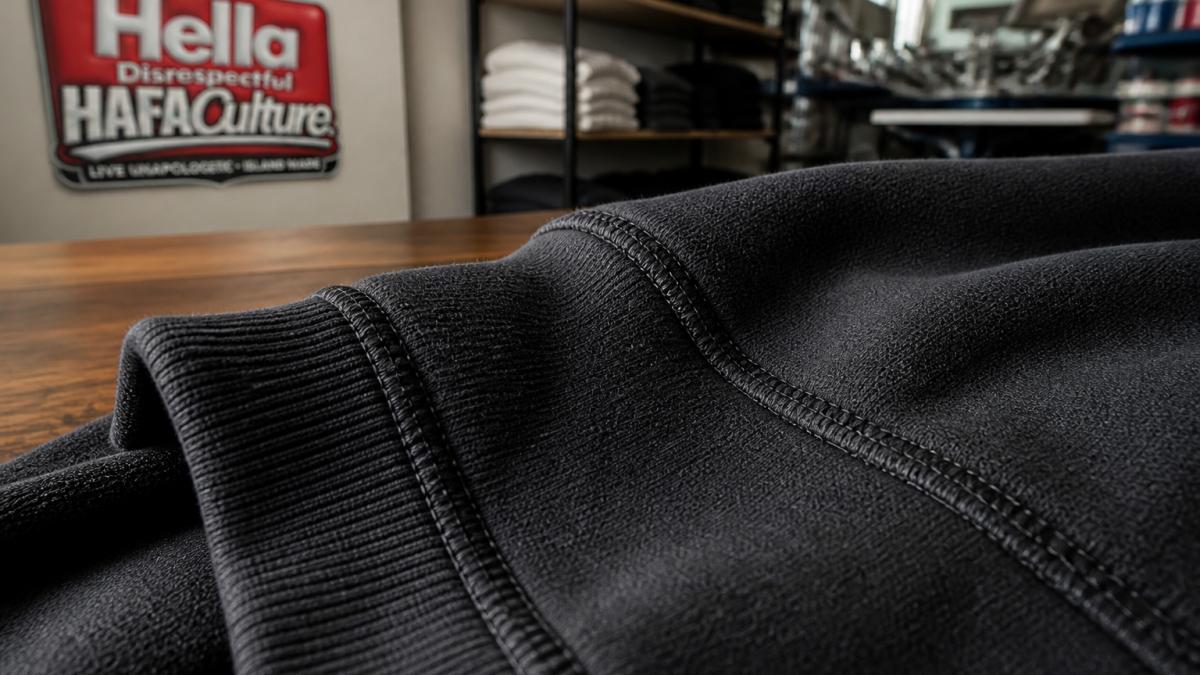
Fabric Weight, Fiber Content, and Seam Durability
Fabric weight is measured in ounces per square yard. A 6.5 oz tee is heavyweight. A 4.2 oz tee is standard weight. A 3.0 oz tee is lightweight.
Heavyweight fabric lasts longer. It resists pilling, holds its shape through washing, and feels premium in hand. The Hella Disrespectful Clothing Mac Bear Tee and Hip Hippo Tee both use 6.5 oz ring-spun cotton, which is the standard for quality streetwear.
Ring-spun cotton is twisted tighter than regular cotton, which makes it smoother and more durable.
Seam construction separates durability from mediocrity. Side-seamed construction means the seams run along the sides of the garment, not down the center of the front and back panels. This keeps seams away from stress points. Flat-lock seams won't unravel.
Quality Assurance, Sampling, and Defect Handling
Before you commit to a bulk order, you need samples. Real samples from the actual manufacturer, not generic mockups. A sample lets you feel the fabric, check the fit, inspect the stitching, and see how your design actually looks on the garment.
Quality assurance means the manufacturer inspects every piece (or at least a statistically significant sample) before shipping. They're checking for loose threads, misaligned prints, color inconsistencies, and seam defects. If defects slip through, you need a clear defect handling policy: what percentage of defects triggers a replacement batch?
Many manufacturers offer sampling services. You order 5-10 pieces to approve before the full production run. This costs more per unit, but it prevents expensive mistakes at scale. Skipping samples to save $50 can cost you thousands if the production run comes back wrong.
Custom Heat Transfers: Application Methods and Longevity
Comparing DTF, Screen Printing, and Embroidery for Long-Term Wear
Three main methods compete for custom apparel printing: DTF transfers, screen printing, and embroidery. Each has different durability profiles.
DTF transfers are flexible, vibrant, and handle complex designs. The film bonds into the fabric, so the transfer moves with the garment. Cost per unit is low, especially on gang sheets.
Screen printing is the old standard. But it's limited to 4-6 colors without color separation complexity, and it requires higher minimums (usually 50+ units per design).
Embroidery is the most durable method. Thread sewn into fabric doesn't fade or crack. Embroidered logos look premium. The downside: embroidery is slow, expensive, and requires specialized equipment.
For brand owners testing designs or running drops under 100 units, DTF printing is the most practical choice. You get durability, no minimums, and fast turnaround.
Total Cost and Unit Economics: Building Your Brand Without Overproduction
Unit cost is where most brand owners get trapped. A bulk order of 500 units looks cheap per piece, maybe $8-12 depending on garment quality and printing method.
On-demand printing costs more per unit ($15-30 depending on garment and print size), but you only pay for what sells. You're not financing inventory you can't move.
The math changes at different volumes. At 50 units, on-demand wins on total cost. At 500 units, bulk manufacturing wins on per-unit cost, but only if you sell most of what you order.
Here's the real question: what's your actual sell-through rate? If you order 500 units and sell 300, your effective cost per unit just doubled.
Brand owners often underestimate how much inventory sits unsold. Overproduction is the silent killer of margins. Conservative ordering keeps you lean and profitable.
Decision Framework: Choosing the Right Production Model for Your Brand
When to Use On-Demand Printing vs. Bulk Manufacturing
Use on-demand printing if:
- You're testing designs and haven't proven demand yet
- Your monthly order volume is under 100 units
- You want zero inventory carrying costs
- You're running seasonal or limited-edition drops
- You need fast turnaround (days, not weeks)
- You want flexibility to adjust colors, sizes, or designs mid-season
Use bulk manufacturing if:
- You've validated demand and you know what sells
- Your monthly volume is 500+ units
- You can absorb inventory risk
- Per-unit cost savings matter more than flexibility
- You have a 4-8 week lead time before you need inventory
- You're scaling and margins are the priority
The transition point is usually around 300-500 units per month. Below that, on-demand makes sense. Above that, bulk manufacturing's per-unit savings start to matter.
Sustainability and Responsible Sourcing Verification
Durability is sustainability. Brands that use heavyweight, high-quality fabric are reducing waste by default.
Responsible sourcing means knowing where your garments come from and what labor practices are involved. Ask your manufacturer:
- Where are the garments made?
- What certifications do they have (Fair Trade, GOTS, OEKO-TEX)?
- What's their labor policy?
- Do they use sustainable materials or renewable energy?
Hella Disrespectful Clothing's on-demand model inherently reduces overproduction waste. You're only making what customers order, not guessing and hoping. That's sustainability built into the production model.
For bulk manufacturing, verify that your supplier is transparent about sourcing. Certifications like GOTS (Global Organic Textile Standard) and OEKO-TEX (chemical safety) are third-party verification that standards are being met.
Choosing the right production model and printing method for your brand comes down to one question: what does your business actually need right now? If you're testing designs and building audience, on-demand printing through services like Hella Disrespectful Clothing's Custom DTF Gang Sheets keeps you flexible and cash-positive.
Frequently Asked Questions
How can I test the durability of durable custom clothing before ordering in bulk?
Request samples from manufacturers before committing to large orders. Test samples through multiple wash cycles using standard detergent and warm water, then inspect for color fading, design cracking, and seam separation. Check fabric softness and stretch recovery after washing. Hella Disrespectful's DTF prints and heavyweight tees are tested for long-lasting wear, so examining their sample quality gives you a realistic preview of what your bulk orders will deliver.
What's the difference between custom DTF printing and other printing methods for durability?
Custom DTF printing transfers designs directly onto fabric using heat, creating a flexible print that moves with the garment and resists cracking through repeated washing. Screen printing offers similar durability but requires minimum orders. Embroidery provides maximum longevity but costs more per unit. DTF balances durability, speed, and affordability, making it ideal for brands needing fast turnaround without bulk minimums. Hella Disrespectful's DTF service delivers vibrant, high-resolution prints built to last.
What fabric specifications should I prioritize when sourcing custom clothing manufacturers?
Look for heavyweight fabric (6+ ounces), ring-spun cotton for softness and durability, and side-seamed construction that prevents unraveling. Charcoal and darker blends often perform better than light colors for color retention. Ribbed collars and reinforced seams extend garment life. Hella Disrespectful's premium heavyweight tees use 6.5 oz ring-spun cotton with side-seamed construction, delivering structured fit and durability that withstands repeated wear and washing.
Should I use on-demand production or bulk manufacturing for my custom clothing brand?
On-demand production eliminates minimum order quantities, reduces waste, and lets you test designs before scaling. It works best for small brands, limited drops, or testing market demand. Bulk manufacturing offers lower per-unit costs once you exceed 100+ units and have proven designs. Hella Disrespectful supports both approaches: their DTF Lab handles single prints and gang sheets with no minimums, while their premium tees use on-demand production to reduce overproduction and waste.