

Durable DTF Printing for Shirts: The 2026 Guide
Table of Contents
- Why DTF Transfers Fail (And What Durability Actually Means)
- The Best Fabric for DTF Transfers: What Bonds and What Doesn't
- Curing and Press Settings That Decide How Long DTF Lasts
- DTF vs Screen Printing Durability: Wash-for-Wash
- DTF Printing Care Instructions That Add Years
- Troubleshooting Peeling, Cracking, and Fading
- Conclusion: Printing Shirts That Survive the Washer
- Frequently Asked Questions
Last Updated: October 4, 2026
Why DTF Transfers Fail (And What Durability Actually Means)
Durable DTF printing for shirts comes down to one thing: a properly cured adhesive layer that survives repeated wash cycles. Direct-to-film transfers are printed on a PET film, dusted with TPU powder, and heat-pressed onto the garment.
Most failures trace back to three culprits: under-curing, wrong pressure, or the wrong fabric for the job. Below, we'll show you how to diagnose each one and what to do instead.
The Best Fabric for DTF Transfers: What Bonds and What Doesn't
The best fabric for DTF transfers is 100% cotton or a cotton-poly blend with at least 50% cotton content. DTF adhesive bonds mechanically to natural fibers, which is why cotton shirts hold prints longer than pure synthetics.
Cotton, Polyester, and Blends Compared
| Fabric | Adhesion | Wash Longevity | Notes |
|---|---|---|---|
| 100% cotton | Excellent | Longest | Best all-around choice |
| Cotton-poly blend | Very good | Long | Balances softness and durability |
| 100% polyester | Moderate | Shorter | Needs lower press temp to avoid scorching |
| Tri-blends | Variable | Moderate | Test before bulk runs |
Pure polyester is the tricky one. It needs lower curing temperatures to avoid scorching, but lower heat can leave the adhesive under-cured. That trade-off is why blends tend to outperform straight polyester for print longevity.
Curing and Press Settings That Decide How Long DTF Lasts
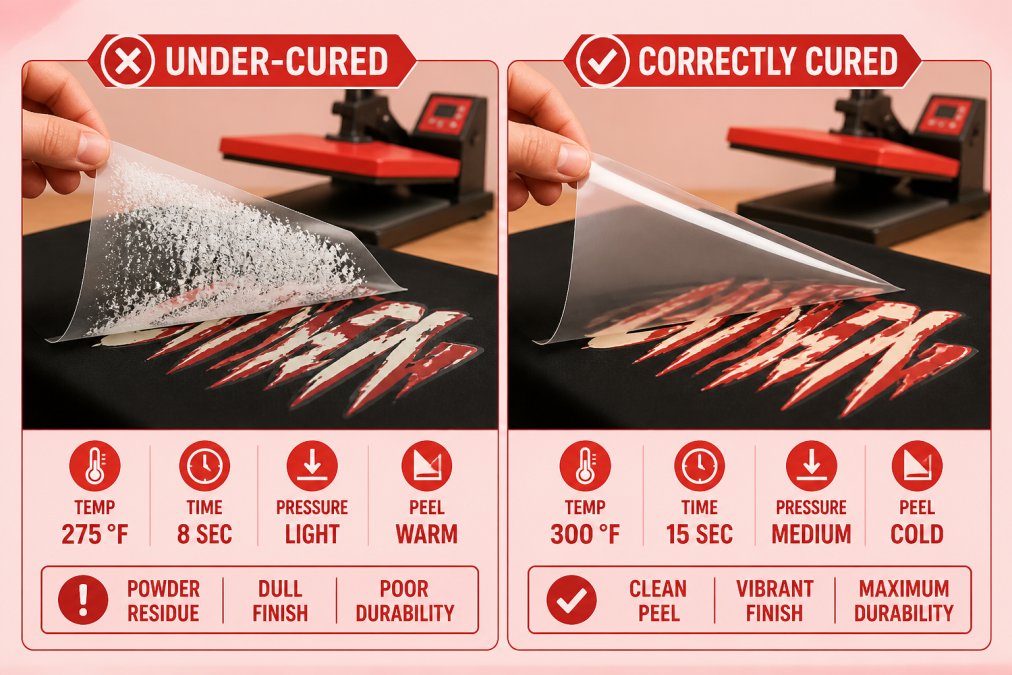
Curing is the single biggest factor in how long a DTF print lasts, because it determines whether the TPU powder actually melts into a continuous adhesive film or stays as a loose dusting of particles.
The cure happens in two stages. The first press melts the TPU powder and drives it into the fabric fibers under pressure. The peel removes the PET carrier.
Standard starting points for a heat press:
- Temperature: 325°F to 350°F for cotton, 275°F to 300°F for polyester
- Pressure: Medium to firm, enough that you can see the fabric texture through the film
- Dwell time: 15 to 20 seconds for the first press, then 5 to 10 seconds for the second press after peeling
Reading the Powder Residue to Diagnose Your Cure
This is the part most guides skip. After you peel the carrier film, look at the back of the film and the surface of the print.
- White, chalky residue on the carrier film after peel: the TPU powder did not fully melt. The adhesive is under-cured. Add 5 seconds of dwell time or bump temperature by 10°F and re-test.
- Glossy, slightly tacky print surface with no visible powder grain: the adhesive melted cleanly. This is what a correct cure looks like.
- Print feels stiff, edges look glazed or shiny, fabric around the print looks scorched: over-cured. Drop temperature by 10°F and shorten dwell time.
A common pattern in small shops is chasing peeling by cranking temperature. That usually makes it worse, because the real problem is dwell time or pressure, not heat. Pressure matters more than most operators realize: if you can't see the fabric weave through the film during the press, you don't have enough pressure for the adhesive to bite into the fibers.
Environmental Conditions Before You Press
Humidity and storage affect the cure more than most people expect. TPU powder is hygroscopic, it absorbs moisture from the air. Film stored in a humid room, or a garage in summer, will press inconsistently even at correct settings. A common pattern is a batch of transfers that presses perfectly on Monday and peels on Friday, with no setting changes in between.
- Store unopened film in a sealed bag with a desiccant pack.
- Bring film to room temperature before pressing if it has been in a cold space.
- Pre-press the garment for 3 to 5 seconds to drive off surface moisture before applying the transfer.
DTF vs Screen Printing Durability: Wash-for-Wash
DTF and screen printing are both durable, but they fail differently. Screen printing fuses ink directly into the fabric, so it can outlast DTF on heavy cotton over many years.
For small runs, one-off designs, and full-color artwork, DTF offers a practical solution. For high-volume single-color prints on heavy cotton, screen printing still has the edge on raw longevity. The gap narrows considerably when DTF is cured correctly.
DTF Printing Care Instructions That Add Years
DTF printing care instructions are simple, and following them can double the life of a print.
The adhesive on a DTF print is a thermoplastic polyurethane film. It is bonded to the fabric mechanically, the melted TPU wraps around individual fibers and locks in as it cools. Anything that softens, dissolves, or lubricates that bond will shorten the print's life.
How Detergents Interact With the TPU Adhesive
Not all detergents are equal when it comes to DTF longevity.
- Standard liquid detergents: fine. They lift soil without attacking the TPU film.
- Powder detergents with oxygen bleach: risky over time. Oxygen bleaches are oxidizing agents, and repeated exposure degrades the polyurethane, making the adhesive brittle. The print may not peel, it will crack instead.
- Chlorine bleach: avoid entirely. It attacks the TPU directly and will cause the print to lift within a handful of washes.
- Fabric softeners and dryer sheets: the biggest silent killer. Softeners deposit a waxy cationic film on fabric, and that film builds up on the print surface and along the edges of the adhesive. Over time, the edge of the print stops bonding and starts lifting. This is why a print that survived 40 washes suddenly peels at wash 45.
If you want one rule that matters more than the rest: no fabric softener, ever, in any form. That single change is the difference between a print that lasts a year and one that lasts three.
Wash, Dry, and Storage Practices
- Turn the garment inside out before washing. This protects the print surface from abrasion against other garments and the drum.
- Use cold water on a gentle or normal cycle. Hot water softens the TPU and stresses the bond.
- Wash DTF-printed shirts separately from items with zippers, hooks, or heavy hardware. Mechanical abrasion is a real failure mode that gets blamed on curing.
- Tumble dry low, or hang dry when possible. A hot dryer cycle is the fastest way to crack a print that would otherwise last for years.
What Actually Shortens Print Life
A useful way to think about DTF care is to sort every action into one of three buckets:
| Action | Effect on the TPU bond |
|---|---|
| Cold wash, inside out, mild detergent | Neutral, bond stays intact |
| Warm wash, no softener | Minor stress, acceptable for most prints |
| Hot wash, softener, hot dry | Cumulative damage, expect cracking and edge lift |
| Bleach, direct ironing, dryer sheets | Direct attack, failure within weeks |
A correctly cured print on 100% cotton, washed cold and dried low with no softener, will typically outlast the shirt. The same print washed hot with softener and dried on high may not survive a season.
American Cleaning Institute guidance on detergent ingredients and fabric care
Troubleshooting Peeling, Cracking, and Fading
Peeling, cracking, and fading each point to a different failure in the process. Peeling at the edges usually means under-curing or too little pressure.
Here's how to isolate each problem:
| Symptom | Likely Cause | Fix |
|---|---|---|
| Edge peeling | Under-cured adhesive | Add dwell time, second press |
| Cracking | Over-stretch or cold peel too early | Reduce pressure, peel at correct temp |
| Fading | Hot wash, detergent residue | Cold wash, no softener |
| Full lift-off | Wrong fabric or no pre-press | Pre-press garment, match fabric |
A quick pre-press of the garment for 3 to 5 seconds before applying the transfer removes moisture and wrinkles, which is one of the fixes most guides skip.
Conclusion: Printing Shirts That Survive the Washer
Durable DTF printing for shirts is a process, not a product. Match the fabric, dial in your cure, and follow basic care rules, and your prints will outlast the shirt they're on.
That's exactly why we built the Hella Disrespectful DTF Lab. We offer custom DTF gang sheets starting at $14.00, single prints from $2.00, and add-on services like heat press application and rush turnaround.

Frequently Asked Questions
Is DTF printing actually durable on shirts?
Yes, when the transfer is cured correctly and the shirt is washed inside out in cold water. Durable DTF printing relies on a TPU adhesive layer that melts into the fabric fibers under heat and pressure. Skip proper curing or wash in hot water and the print will crack or peel within a handful of cycles. Follow the press and care specs and the print holds up for the life of the garment.
How many washes can a high-quality DTF transfer withstand?
A properly cured DTF transfer on a compatible fabric typically holds up for 50 or more wash cycles without visible cracking or fading. The variables that shorten that number are wash temperature, dryer heat, and detergent choice. Cold water, low dryer heat, and no fabric softener keep the adhesive layer intact far longer than hot-water washing and high-heat drying.
What factors cause DTF transfers to crack or peel prematurely?
Four causes cover most failures: under-curing (too little heat, time, or pressure), pressing on a fabric the adhesive can't bond to, washing in hot water, and stretching the print while the shirt is still hot. Scorching during pressing also weakens the film. Each of these breaks the bond between the TPU powder and the fabric, which is what shows up later as peeling edges or spiderweb cracking.
What is the best fabric for maximizing DTF print longevity?
Cotton and cotton-heavy blends give DTF transfers the strongest, longest-lasting bond because the adhesive grips the natural fibers well. 100% polyester also works, but requires lower press temperatures to avoid scorching and dye migration. Stretchy performance fabrics and heavy moisture-wicking synthetics are the hardest to bond to, so expect shorter print life on those.
How does DTF durability compare to screen printing?
Screen printing wins on raw longevity for high-volume orders on cotton. The ink cures into the fabric and can outlast the shirt itself. DTF holds its own on detail, color range, and small runs, and a well-cured transfer survives dozens of washes. For stretchy fabrics and full-color designs, DTF often lasts longer than a screen print that cracks because the ink can't flex with the garment.
Can I fix a DTF transfer that has already started peeling?
Sometimes. If the edges are lifting but the print is otherwise intact, re-press it with a heat press at the original curing temperature for 10 to 15 seconds with firm pressure. This re-melts the adhesive and re-bonds the lifting area. Once a transfer has cracked through the middle or lost large sections, it can't be repaired and needs to be replaced.
Does washing inside out really make a difference for DTF shirts?
It does, and it's one of the highest-impact care steps. Turning the shirt inside out puts fabric between the print and the drum of the washer and dryer, which reduces the abrasion that wears down the transfer surface. Combined with cold water and low heat, inside-out washing can add dozens of cycles to the life of a DTF print.
What heat press settings give the most durable DTF prints?
Most DTF films cure at 300 to 325 degrees Fahrenheit for 10 to 15 seconds with medium-to-firm pressure, then a second press of 5 to 10 seconds after the film is peeled. Cold peel films need the shirt to cool before peeling, hot peel films come off while warm. Always follow the film manufacturer's spec, since curing temperature, dwell time, and pressure settings vary by product.