

How to Spot Counterfeit Streetwear Sneakers in 7 Steps
Quick Summary
To spot counterfeit streetwear sneakers, check the stitching for even, tight lines with no loose threads, then inspect the material texture and finish. Compare logos and lettering against verified product photos, and confirm that the style code matches on the box, size tag, and original listing.
- Real pairs have tight, even stitch lines that run straight along the panels.
- Check that the style code matches on the box label, size tag, and product listing.
- Fakes often show glue stains, uneven panel cuts, and strong chemical smells.
- Compare logos and tongue labels against verified product photos from a trusted source.
- Treat a pair as suspect if its price is far too low for a sought-after release.
Table of Contents
- Why Streetwear Sneakers Get Counterfeited So Often
- Step 1: Check the Stitching for Consistency and Loose Threads
- Step 2: Inspect Material Quality, Texture, and Finish
- Step 3: Examine Logos, Lettering, and Tongue Details
- Common Signs of Counterfeit Shoes You Can Spot Without Tools
- Step 4: Verify the Box, Labels, Size Tag, and Style Code
- Using Sneaker Authentication Apps and Services
- StockX vs GOAT Authentication Process: Which Route to Trust
- Frequently Asked Questions
Why Streetwear Sneakers Get Counterfeited So Often
Last Updated: October 29, 2026
Counterfeit streetwear sneakers are everywhere, and the reason is simple: limited releases sell out fast, resale prices climb, and every drop creates a new target for fakers.
Here's the thing. Most fakes don't look bad from across the room. They look bad up close, once you know where to look. That's the good news.
Fakes thrive in a few predictable situations:
- Hyped releases with long waitlists and high resale prices
- Collaborations that are hard to find at retail
- Listings with stock photos instead of real product shots
A common mistake is buying the first pair that looks close enough. Slow down and check the details.
Step 1: Check the Stitching for Consistency and Loose Threads
Start with the stitching, because it's one of the hardest things for counterfeiters to get right. Real pairs have tight, even stitch lines that run straight along the panels.
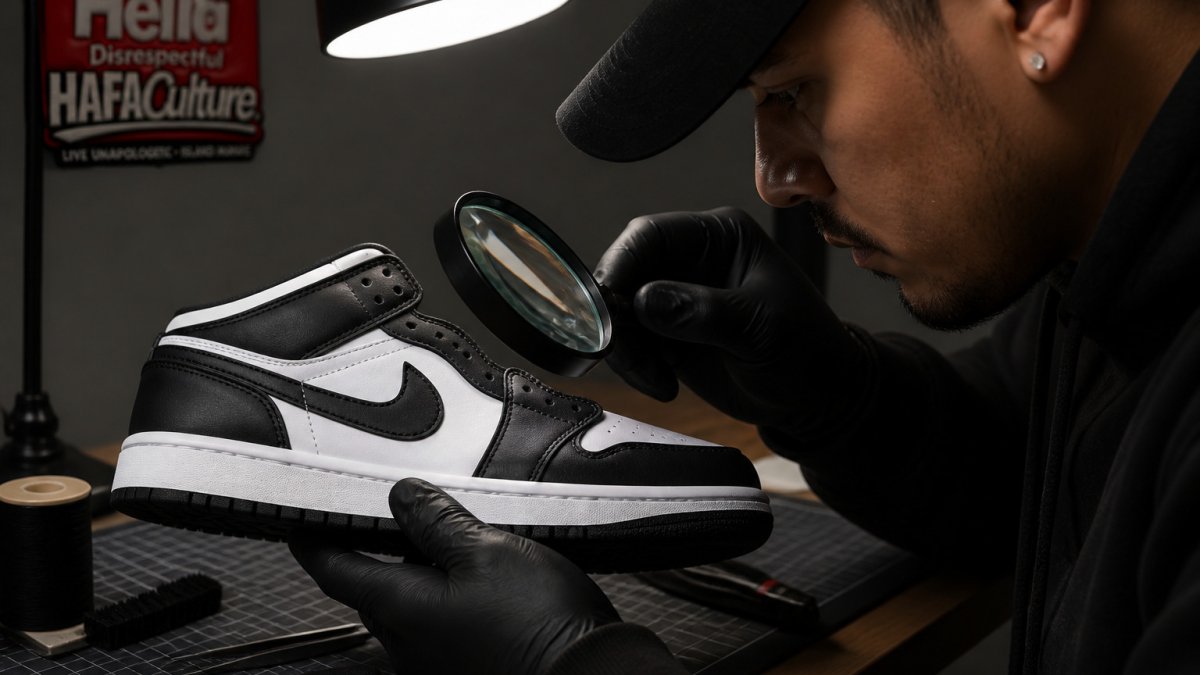
Look for these signs:
- Stitches that are evenly spaced and the same length throughout
- No loose threads or frayed ends sticking out
- Clean stitch lines that don't wander or double back
Fakes often show crooked lines, uneven gaps, or thread that looks thin and fuzzy. Hold the shoe under good light and run your eye along each seam.
Step 2: Inspect Material Quality, Texture, and Finish
Next, feel and look at the materials. Genuine leather, suede, and knit uppers have a consistent texture and finish across the whole shoe.
- Check that the leather or suede feels smooth and substantial, not stiff or plasticky
- Look for an even finish without shiny patches or dull spots
- Compare the upper, midsole, and outsole for matching quality
Counterfeit pairs often use cheaper materials that feel thin, smell strongly of glue, or look different from one panel to the next.
Step 3: Examine Logos, Lettering, and Tongue Details
Logos and lettering are where many fakes give themselves away. Look closely at spacing, font weight, and alignment.
- Compare logos against verified product photos from a trusted source
- Check that letters are evenly spaced and cleanly printed or embroidered
- Inspect the tongue label, which often has specific wording and placement on authentic pairs
Mismatched fonts or sloppy edges on a logo are strong warning signs.
Common Signs of Counterfeit Shoes You Can Spot Without Tools
You don't need special equipment to catch many fakes. Watch for these common signs of counterfeit shoes:
- Glue stains or excess adhesive around the sole or collar
- Uneven cuts or panels that don't line up symmetrically
- A strong chemical smell instead of a neutral one
If you notice more than one of these, treat the pair as suspect until you verify it. Explore a broader guide to identifying authentic streetwear to build on these signs.
Step 4: Verify the Box, Labels, Size Tag, and Style Code
Packaging and internal tags are where counterfeiters cut the most corners, because most buyers never look inside the shoe. For a full walkthrough of every check, see the complete legit-check steps. This is also the step where streetwear releases, limited drops, collaborations, and regional exclusives, diverge most from general sneaker advice, so slow down here.
What a style code actually is
A style code (sometimes called a style number or product code) is the alphanumeric identifier the brand assigns to a specific colorway of a specific model. It is not the same as the model name. Two pairs can share a silhouette but carry different style codes because the colorway, material, or collaboration differs. On most athletic and streetwear sneakers the code appears in three places:
- Printed on the box label, usually next to the size and color description
- On a size tag inside the tongue or on the inner collar
- Sometimes on a hangtag or insert included with the pair
A common pattern is a format like DD1391-100, where the letters and first block identify the model and the final block identifies the colorway. Formats vary by brand, so treat the pattern as a clue, not a rule.
How to cross-check the code
- Read the code off the box label first.
- Find the size tag inside the shoe and confirm the same code appears there.
- Compare both against the code shown in the original product listing or the brand's own product page for that release.
- If any of the three disagree, stop. A mismatch between box and shoe is one of the most reliable counterfeit signals because fakers often pair a real box with a fake shoe, or the reverse.
brand product page or official release archive
Streetwear-specific traps
Limited drops and collaborations create legitimate variation that trips up buyers in both directions, missing real pairs and passing fakes.
- Collaboration codes. Collab releases often carry their own style code that differs from the general-release version of the same silhouette. Confirm the code against the collaborator's announced release, not the base model.
- Regional releases. The same colorway sold in different regions can carry different packaging, language on the box label, or slightly different tag layouts. A non-US box label is not automatically fake, check the code and the release region before deciding.
- Factory variation. Production runs from different factories can show small differences in tag stitching, label placement, and print weight. Variation alone is not proof; a code mismatch plus sloppy print is.
- Re-releases and restocks. A restocked pair may ship in updated packaging. Compare against the packaging from the same production window, not an older unboxing video.
Box and label details worth a second look
- Print quality: sharp text, correct fonts, no smudging or misaligned lines
- Label placement: centered and square, not crooked or peeling at the corners
- Color accuracy: box print should match the colorway, not look washed out or oversaturated
- Size tag: font weight and spacing should be consistent with other authentic pairs from the same brand
If the box looks right but the shoe fails the stitching or material checks, trust the shoe. Packaging is the easiest thing to fake well.
Packaging and internal tags are where counterfeiters cut the most corners, so the article's main checks are summarised below.
| Check | Where to find it | Red flag |
|---|---|---|
| Style code | Box label, size tag, hangtag | Code differs between box and shoe |
| Collaboration code | Collab release announcement | Base-model code used on a collab |
| Box print quality | Box label and print | Smudged text, washed-out colour |
| Label placement | Box and size tag | Crooked or peeling corners |
| Size tag font | Inside tongue or collar | Weight and spacing inconsistent with genuine pairs |
| Regional release | Box label language and release region | Assumed fake without checking the code |
Using Sneaker Authentication Apps and Services
Authentication services are a useful second layer, but they are not a guarantee, and the streetwear resale market is full of pairs that passed a check and still turned out wrong. Understanding how these services actually work, and where they fail, is more useful than a list of app names.
The three routes you will encounter
1. Marketplace in-house authentication. Large resale marketplaces employ authenticators who physically inspect pairs before shipping to the buyer. The pair goes from seller to the marketplace's facility, gets checked, then ships to you.
2. Third-party authentication and legit-check services. Independent services review photos you submit and return an opinion. Some also offer physical inspection by mail.
3. Community legit checks. Forums and social communities offer free opinions from experienced collectors.
What to check before you rely on any service
- Photo requirements. Does the service specify which angles, tags, and labels it needs? A service that accepts two blurry photos is not doing a real check.
- Turnaround time. Physical authentication adds days; photo checks can be same-day. Know which you are getting.
- What happens on a fail. Does the service refund, return the pair, or just tell you it is fake? The answer determines your actual protection.
- Scope. Does the service authenticate the specific model and collaboration you are buying, or only general-release sneakers? Streetwear collabs are where coverage is thinnest.
marketplace authentication policy page
The limits of authentication, and why they matter
Authentication is a filter, not a proof. Three limits are worth internalizing:
- Visual checks have a ceiling. High-tier fakes are built to pass a visual inspection. Authenticators rely on the same stitching, material, and tag cues you do, plus experience and reference pairs. When a fake is good enough, the check becomes a judgment call.
- Photo checks miss physical cues. Smell, weight, midsole feel, and in-hand material texture do not survive a photo. A photo-based pass tells you the pair looks right in pictures, not that it is right.
- Pass rates are not published in a comparable way. Different services use different standards, so a pass from one is not equivalent to a pass from another. Do not treat a pass as transferable.
A practical order of operations
- Run your own visual and tag checks first, they are free and fast.
- If the pair passes, use a service as confirmation, not as a substitute for your own inspection.
- If the service and your inspection disagree, trust the more conservative result and do not complete the purchase until the discrepancy is resolved.
- Keep the service's verdict and your photos on file, they matter if you later need to dispute a payment or request a refund.
StockX vs GOAT Authentication Process: Which Route to Trust
Compare them based on:
- Which items they authenticate and how long the process takes
- Their buyer protection terms and what they cover
- How easy it is to access their official policies on their websites
Check each platform's current terms directly before you buy, since policies change over time.
Frequently Asked Questions
How do you know when sneakers are fake?
No single sign proves a pair is fake, but a combination of problems is a strong warning. Look for uneven or loose stitching, glue stains, off-center logos, lettering with wrong fonts or spacing, and a box or size tag that does not match the style code printed on the shoe. Compare the pair against verified product photos from the same release, since legitimate versions of a model can vary by factory run. When several details look wrong at once, treat the pair as suspect and verify it through an authentication service before paying.
Is GOAT or StockX better for buying authentic sneakers?
Both platforms run their own authentication before shipping items to buyers, so neither is automatically better for every purchase. Check each platform's current authentication policy on its website, since processes change over time. Using an authenticated marketplace reduces risk, but it does not remove the need to check the item you receive.
Is buying counterfeit shoes illegal?
In the United States, buying counterfeit goods for personal use is generally not a federal crime, but selling them is, and trademark owners can pursue civil claims against sellers. Customs authorities can also seize counterfeit goods at the border. Because rules vary and enforcement differs, check current guidance from U.S. Customs and Border Protection or consult an attorney if you have questions about a specific situation. Keep records of your purchase, since they help if you need to dispute a seller or file a claim.
Is there a free app for authenticating shoes?
Some sneaker authentication apps offer free basic features, while formal authentication of individual pairs may carry a separate cost. Free tools can help you compare a pair against reference photos and spot obvious differences, but they do not replace a hands-on inspection or a formal authentication. Confirm current features directly in each app, because offerings change. Use free tools as a first filter, then send higher-value or uncertain pairs to a professional service.
