

How Do You Wash Graphic Streetwear Tees Without Ruining the Print?
Last Updated: October 25, 2026
Quick Summary
Wash graphic streetwear tees inside out in cold water on a gentle or delicate cycle with mild detergent, then air dry them. Skip fabric softener, bleach, and high heat, since heat, friction, and harsh detergent are what crack and fade prints. Turning the tee inside out is the single most important step.
- Set your machine to cold water and the gentlest cycle it has.
- Keep the load loose, never packed, to reduce friction on prints.
- Air dry graphic tees away from direct sunlight to prevent fading.
- You don't need to wash a graphic tee after every single wear.
- Blot stains, don't rub, and avoid harsh removers on the printed area.
Table of Contents
- Why Your Graphic Streetwear Tees Fall Apart in the Wash
- The Step-by-Step Wash: Inside Out, Cold Water, Gentle Cycle
- The Best Water Temperature for Washing Graphic Tees
- How to Prevent Graphic Tee Prints From Cracking
- How to Dry Graphic T-Shirts Without Fading
- DTF Print Care Instructions: What Direct-to-Film Needs
- Stains, Odor, and Washing Frequency for Printed Tees
- Shop the Drops and Wear Them Loud
- Frequently Asked Questions
Why Your Graphic Streetwear Tees Fall Apart in the Wash
Most graphic streetwear tees don't die from wearing them. They die in the laundry room. At Hella Disrespectful Clothing, we've watched customers ruin a perfectly good printed tee in one hot wash, and it stings every time.
The print is the fragile part. The cotton can take a beating. The ink can't.
So before you learn how to wash graphic streetwear tees the right way, you need to know what's actually attacking them.
The Three Enemies: Heat, Friction, and Harsh Detergent
Three things break down a graphic print: heat, friction, and harsh detergent. Every bad wash habit traces back to one of them.
- Heat softens the ink bond and makes it brittle once it cools
- Friction grinds the print against other fabric in the drum
- Harsh detergent strips color and breaks down the print's outer layer
The American Cleaning Institute's laundry guidance backs the basics here: cooler water and gentler cycles protect fabric and color longer.
A common mistake is assuming "delicate" means "not clean." It doesn't. Gentle agitation still cleans a tee you wore once.
The Step-by-Step Wash: Inside Out, Cold Water, Gentle Cycle
Here's the full process, start to finish. Follow it and your print stays sharp for years, not weeks.
- Turn the tee inside out so the print faces inward
- Close zippers and empty pockets on other items in the load
- Set the machine to cold water and a gentle or delicate cycle
- Add a mild detergent, no more than the label suggests
- Skip fabric softener and bleach entirely
- Wash with similar colors and similar fabric weights
- Remove the tee as soon as the cycle ends
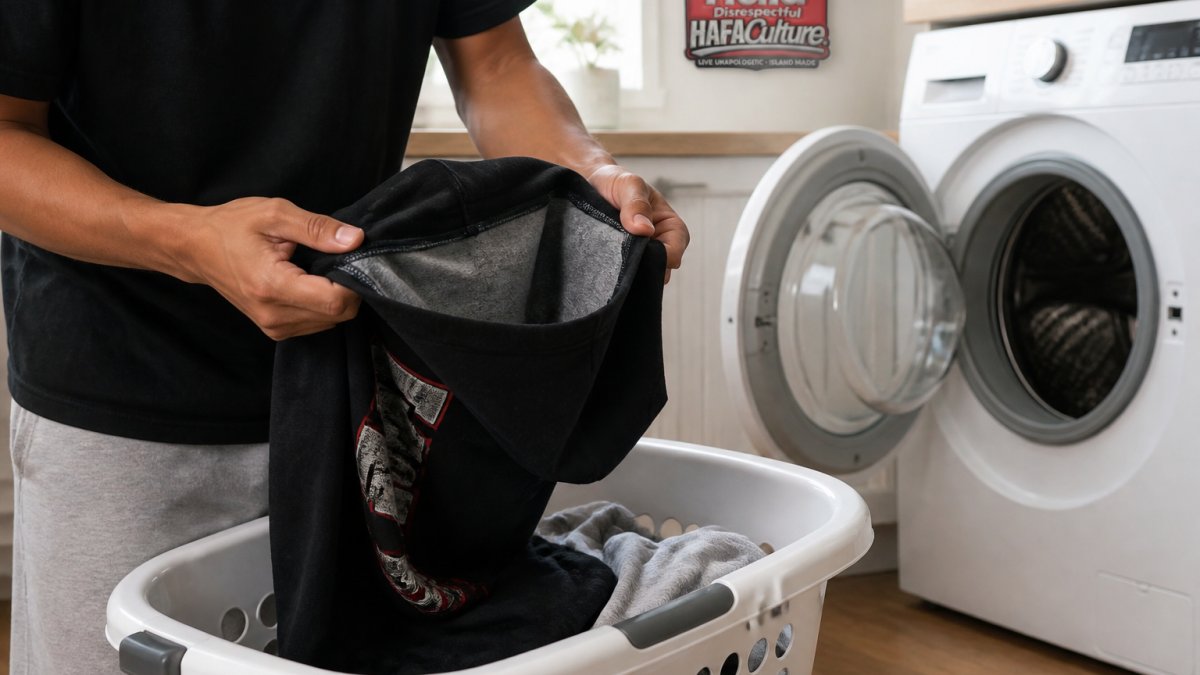
Turning it inside out is the single most important step. It puts the print against itself instead of against a zipper, a button, or a rough seam.
Washer Settings and Load Management
Set your machine to the gentlest cycle it has, and use cold water. That's the short answer.
Load size matters more than most people think. A stuffed drum means more friction and more abrasion on every print. A half-full drum gives tees room to move without grinding.
- Use the delicate or hand-wash cycle
- Choose a low or medium spin speed
- Keep the load loose, never packed
- Wash printed tees with soft items, not jeans or towels
- Check the care label first, always
If you're protecting the neckline and shape too, our guide on preventing shirt neckline deformation covers the wash habits that keep a collar from stretching out.
Here's the full wash process at a glance, from turning the tee inside out to pulling it from the drum.
| Step | What to do |
|---|---|
| 1 | Turn the tee inside out so the print faces inward |
| 2 | Close zippers and empty pockets on other items |
| 3 | Set machine to cold water and gentle or delicate cycle |
| 4 | Add mild detergent, no more than the label suggests |
| 5 | Skip fabric softener and bleach entirely |
| 6 | Wash with similar colors and similar fabric weights |
| 7 | Remove the tee as soon as the cycle ends |
The Best Water Temperature for Washing Graphic Tees
Cold water is the best water temperature for washing graphic tees. Set it to cold and leave it there.
Heat is what makes ink crack and dye fade. Warm water speeds up that breakdown, and hot water accelerates it further. Cold water cleans a normal-wear tee just fine.
Some care labels list a specific temperature, often around 30°C. Follow the label over any general rule. When in doubt, colder is safer.
The one exception: heavily soiled workwear may need a warmer wash. Spot-treat the stain first and keep the print out of the heat as much as possible.
How to Prevent Graphic Tee Prints From Cracking
The best way to prevent graphic tee prints from cracking is to stop the three enemies before they start: no heat, no friction, no harsh detergent.
Cracking happens when the ink bond weakens and then flexes. Heat weakens it. Friction flexes it. Harsh detergent eats at it from the outside.
- Wash inside out, every single time
- Keep water cold
- Skip the dryer or use the lowest heat setting
- Never iron directly over the print
- Avoid bleach and detergents with optical brighteners
- Don't wash a graphic tee after every single wear
If a print is already cracking, you can slow it down but not reverse it. A gentle wash and air drying will keep the damage from spreading. For a deeper look at causes and fixes, read why custom apparel prints crack.
WANTED: MAC BEAR TEE — PREMIUM HEAVYWEIGHT EDITION →
How to Dry Graphic T-Shirts Without Fading
Air dry your graphic T-shirts to prevent fading. Hang them or lay them flat, away from direct sun.
High heat from a dryer is the fastest way to fade a print and shrink a cotton tee. Tumble drying on high also adds friction as the shirt bounces around the drum.
- Hang dry on a plastic hanger, inside out
- Or lay flat on a drying rack to protect the shape
- Keep them out of direct sunlight
- If you must use a dryer, choose the lowest heat setting
- Remove while slightly damp to avoid over-drying
Flat drying is better for heavyweight tees because it stops the shoulders from stretching on the hanger. For a tee like our 6.5 oz heavyweight cotton, flat drying keeps the structured fit intact.
DTF Print Care Instructions: What Direct-to-Film Needs
DTF prints need the same cold, gentle, inside-out treatment as any other print, plus a little extra patience with heat. But DTF is only one of several print methods on streetwear tees, and each one fails differently. The care label still wins, but here's how the major print types respond so you can adjust when the label is vague.
Care by print method
Screen print. Cured plastisol ink sits on top of the fabric and is the most wash-tolerant of the common methods. It still cracks when heat and flexing weaken the bond, so cold water, inside-out washing, and air drying remain the baseline. Avoid ironing directly on the print; if you must press the shirt, do it from the inside out or through a pressing cloth.
Direct-to-Garment (DTG). DTG ink soaks into the fibers, so it feels softer but can fade faster with abrasion and harsh detergent. Wash inside out, skip optical brighteners and bleach, and expect some softening of the image over time, that's normal, not a defect. Air drying protects color more than any detergent choice.
DTF (Direct-to-Film). A printed film is bonded to the fabric. That bond is durable but heat-sensitive, and hot water or a hot dryer are the two fastest ways to break it down. Wash inside out in cold water, use mild detergent only, skip bleach, softener, and harsh stain sticks, and air dry or tumble on the lowest heat. Wait before washing a brand-new DTF print, and never iron over it.
Heat transfer and vinyl. These are pressure- and heat-applied films. They are the most heat-sensitive of the group: a hot dryer can lift edges, and an iron directly on the film can melt or distort it. Wash inside out, cold, gentle, and air dry. If an edge lifts, a pressing cloth and low iron from the back side can sometimes re-adhere it, but don't iron the face of the film.
What every print method has in common
- Cold water and a gentle cycle
- Inside out, every wash
- Mild detergent, no bleach or fabric softener
- Air dry or the lowest heat setting
- No direct ironing on the print
If your DTF print feels stiff or heavy after a wash, that's common and usually temporary. Our article on why DTF prints feel heavy after washing explains what's happening and how to handle it.
Stains, Odor, and Washing Frequency for Printed Tees
You don't need to wash a graphic tee after every wear. Spot-treat stains and air the tee out between washes to extend its life.
Overwashing is a real problem. Every cycle adds a little more friction and a little more wear to the print. If a tee passes the sniff test and has no visible marks, hang it up and wear it again.
For stains on or near the print:
- Blot, don't rub, to avoid pushing the stain into the ink
- Use a small amount of mild detergent and cold water
- Work from the outside of the stain inward
- Rinse cold and air dry
- Avoid harsh stain removers on the printed area
For odor, a short air-out on a hanger usually does the trick. A cold, gentle wash handles the rest.
Shop the Drops and Wear Them Loud
Care is only half the battle. The other half is starting with a tee worth protecting.
Our heavyweight tees are built from 100% combed ring-spun cotton at 6.5 oz, with side-seamed construction and a ribbed collar that holds its shape. The WANTED: MAC BEAR TEE, PREMIUM HEAVYWEIGHT EDITION is $25 and made to take a proper wash cycle without falling apart.

Follow the care steps above and a bold print stays bold. Want outfit ideas once your tee is clean and ready? We've got ways to style oversized graphic tees that make the print the whole point.
Frequently Asked Questions
Should I turn graphic tees inside out before washing?
Yes. Turning the shirt inside out puts the fabric between the print and the wash tub, so the graphic rubs against cotton instead of the drum and other garments. That one step cuts the friction that causes cracking and peeling on screen print, DTF, and vinyl designs. Pair it with cold water and a gentle cycle and your graphic streetwear tees hold their print far longer than a standard hot wash.
Can I put graphic tees in the dryer?
You can, but low heat or no heat only. High heat softens the plastisol or film layer of the print and shrinks the cotton underneath it, which is how prints crack. Air drying flat or hanging is the safest route. If you need the dryer, use the lowest setting and pull the shirt out while it is still slightly damp, then hang it to finish.
What water temperature is best for washing printed T-shirts?
Cold water, around 30°C or below, is the safe default for any printed tee. Cold water keeps the print adhesive stable, limits color loss, and reduces shrinkage in 100% cotton. Hot water speeds up fading and weakens the bond between print and fabric. If a care label allows warm, stay on the cooler end anyway for anything with a large front or back graphic.
How do I remove stains from a graphic tee without damaging the print?
Blot the stain, do not rub it. Apply a small amount of mild detergent directly to the stain and let it sit for 10 to 15 minutes, then rinse in cold water. Avoid bleach, optical brighteners, and harsh stain sticks on or near the printed area. For grease, a drop of dish soap on the fabric side, not the print side, works well. Repeat gently rather than scrubbing hard.
Your prints shouldn't fade before the design does. Hella Disrespectful Clothing builds heavyweight tees with DTF transfers made to survive real wear and real wash cycles. Shop the drops, follow the care steps, and wear them loud. Get started with Hella Disrespectful Clothing and keep your graphics sharp for the long haul.
