

Meaningful Cultural Clothing Design Tips for 2026
Table of Contents
- Why Cultural Clothing Design Needs More Than Good Intentions
- How to Research Cultural Symbols for Apparel
- Cultural Appropriation vs Appreciation in Fashion: Where the Line Actually Sits
- Turning Symbolism Into Garment Construction That Holds Up
- DTF Printing for Custom Cultural Designs: What Independent Brands Get Wrong
- Ethical Sourcing and Supply Chain Transparency for Cultural Apparel
- Digital Preservation: Keeping Traditional Techniques Alive in Modern Design
- Conclusion: Design That Speaks for Itself
- Frequently Asked Questions
Last Updated: September 25, 2026
Why Cultural Clothing Design Needs More Than Good Intentions
Meaningful cultural clothing design starts with a hard truth: a great-looking graphic is not the same as a respectful one. At Hella Disrespectful Clothing, we build designs around real island cultures, so we know the difference between a shirt that honors a heritage and one that borrows it.
How to Research Cultural Symbols for Apparel
Research is the whole job. Skip it and everything downstream falls apart.
Start With Primary Sources, Not Pinterest
Pinterest and mood boards flatten meaning into decoration. Primary sources keep it intact.
- Museum archives and university textile collections
- Community elders and cultural centers
- Published textile history and academic papers
- Regional artisans who still make the work by hand
Document Your Sources Before You Sketch
Write down where every motif comes from before you draw a line.
- Source name and community
- Symbol meaning and proper use
- Permission status, if required
- Any restrictions on placement or color
Cultural Appropriation vs Appreciation in Fashion: Where the Line Actually Sits
Cultural appropriation in fashion is taking a sacred or meaningful symbol without consent, context, or credit. Cultural appreciation is using it with permission, understanding, and respect. The line sits at consent and context, not aesthetics.
The Four-Layer Test
Run every motif through these four layers in order. If a design fails any layer, fix it before moving on.
- Origin. Can you name the specific community, region, and era the motif comes from? "Polynesian" is not an origin. "A Marquesan-style tiki carved in the 19th century on Nuku Hiva" is. If you cannot get that specific, you do not have enough research yet.
- Function. What did the motif do in its original context? Some patterns marked rank, some marked mourning, some were ceremonial-only, and some were everyday decoration. A motif that was everyday decoration carries far fewer restrictions than one tied to a rite of passage.
- Permission. Who has the authority to say yes? For some communities that is an individual artisan. For others it is a council, a family line, or a cultural center. Consent from one person is not consent from a community that vests authority elsewhere.
- Position. Where does the design sit on the body and on the garment? Placement carries meaning. A motif meant for a shoulder or a back can lose its intent when shrunk onto a pocket or stretched across a hem.
The Three Failure Modes Designers Actually Hit
In practice, appropriation in apparel rarely looks like a cartoon villain. It looks like one of these:
- The flattening failure. A motif with a specific meaning gets treated as a texture or a background pattern. The fix is to give the motif a job in the design, not just a spot in the layout.
- The mashup failure. Two unrelated sacred motifs from different cultures get combined because they look good together. The fix is to keep sacred elements in their own context and use non-sacred elements for cross-cultural layering.
- The credit failure. The design is respectful but the brand never names the source community, never pays the artisan, and never shares proceeds. The fix is a written credit and a compensation agreement before the design ships.
What Appreciation Looks Like in Practice
Appreciation is not a vibe. It is a set of concrete commitments:
- A named source community on the product page, not just "inspired by island culture"
- A compensation or royalty arrangement with the artisan or community organization
- A design review with a community representative before the first production run
- A public correction process if the community later objects to how a motif was used
Turning Symbolism Into Garment Construction That Holds Up
A meaningful design means nothing if the print cracks after two washes. Construction is where respect meets reality.
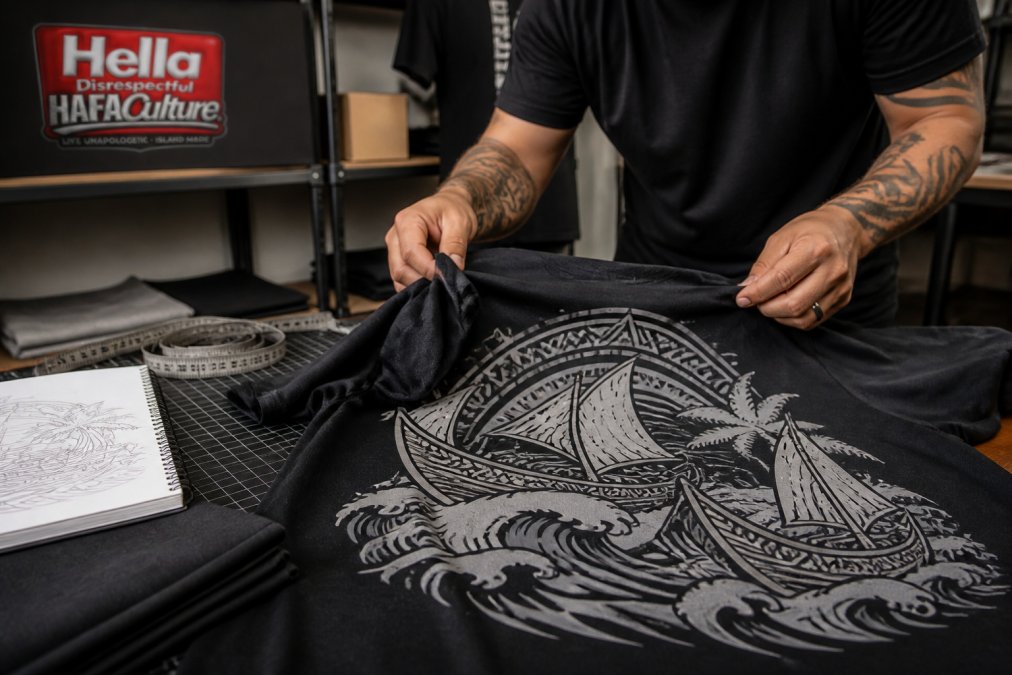
Placement, Scale, and Print Durability
Placement matters for meaning. Some motifs belong on the back, some on the chest, some nowhere near a hem.
- Fabric weight and weave
- Print method and cure temperature
- Wash-test results after five cycles
- Stretch recovery at the neckline
DTF Printing for Custom Cultural Designs: What Independent Brands Get Wrong
DTF printing for custom cultural designs fails most often on color accuracy and detail loss. Direct to Film transfers fine lines and gradients well, but only when the file, film, and press are dialed in.
Common mistakes we see:
- Low-resolution art that blurs fine motif lines
- Wrong pressure, which smears detail
- Inconsistent cure temps, which cause cracking
- No color proof before a full run
Ethical Sourcing and Supply Chain Transparency for Cultural Apparel
Ethical sourcing means knowing who made your blank, where the cotton came from, and how the people who touched it were treated. Transparency means proving it. Most brands can't: they buy blanks from a middleman and never ask questions, and that gap is where exploitation hides. Here is how to actually do it.
Tier 1 Through Tier 4: Know How Far Back You Can See
Supply chains run in tiers, and most brands only see the first one.
- Tier 1 is the cut-and-sew factory that assembled your blank. This is the easiest tier to identify and the one most brands stop at.
- Tier 2 is the fabric mill that wove or knit the material. Fewer brands can name this one.
- Tier 3 is the yarn spinner and the dye house. Very few brands can name this one.
- Tier 4 is the raw fiber source, the farm or the recycler. Almost no brand can name this one.
How to Verify a Supplier Claim
A supplier telling you they are ethical is not verification. Verification is documentation you can check.
- Ask for the factory name and street address, not just the country. Then look the address up on a map and confirm it is a real production facility.
- Ask for a current social compliance audit. Common frameworks include WRAP, BSCI, and SA8000. Read the audit date, the findings, and any corrective action plan, not just the certificate cover page.
- Ask for the mill's fiber traceability documents. For cotton, that often means a transaction certificate under a recognized chain-of-custody standard.
- Ask for wage records for the specific production line that runs your order. A factory-wide average hides the lowest-paid workers.
- Ask what happens when an audit finds a violation. A supplier with a written remediation process is safer than one that claims a perfect record.
Red Flags in a Supplier Conversation
Most sourcing problems show up in the first three emails. Watch for these:
- The supplier will not name the factory, only the country
- The supplier offers a certificate with no audit date or auditor name
- The price is far below the market rate for the fabric weight and construction you asked for
- The supplier cannot explain how they handle overtime during peak season
- The supplier pushes you to skip a sample and go straight to bulk
What to Disclose on Your Own Product Page
Transparency is not just about what you know; it's about what you tell your customer. A credible cultural apparel brand can publish:
- The Tier 1 factory name and location
- The fabric weight, fiber content, and country of origin
- The print or embroidery method and where it was applied
- The name of the source community or artisan behind any cultural motif
- Any certification the blank or the factory holds
The Cost Trade-Off Nobody Mentions
Traceable, fairly made blanks cost more. A verified Tier 2 mill with documented labor standards typically runs a meaningful premium over an untraced commodity blank. That premium has to come out of either your margin or your retail price. There is no third option.
Digital Preservation: Keeping Traditional Techniques Alive in Modern Design
Digital preservation is the practice of recording traditional techniques, patterns, and meanings in durable digital form so they survive and stay accurate. It's one of the most underused tools in cultural apparel.
Here's how to do it:
- Photograph and scan original textiles at high resolution
- Record the maker explaining the technique on video
- Write down the symbol's meaning and proper use
- Store everything with the community, not just your brand
- Credit the source every time you reference it
Conclusion: Design That Speaks for Itself
The real challenge in cultural clothing design is earning the right to tell someone else's story. That takes research, consent, and craft that holds up wash after wash.
Quick Reference: Common Mistakes and Fixes
| Mistake | Fix | Why It Matters |
|---|---|---|
| Using symbols without research | Talk to community sources first | Prevents appropriation |
| Low-res art files | Scan or redraw at high resolution | Keeps fine motifs sharp |
| No wash testing | Test five cycles before selling | Avoids returns and refunds |
| Unknown blank suppliers | Demand factory and labor details | Protects workers and your brand |
| No source records | Document every motif's origin | Proves intent and credit |
Frequently Asked Questions
How do you incorporate cultural elements into modern fashion design without appropriation?
Start by researching the specific cultural clothing design elements you want to use. Identify who created the symbol, what it means, and whether it is sacred or restricted. Then ask: does your design add context or just extract aesthetics? If you cannot explain the meaning behind a motif, you are not ready to print it. Brands like Hella Disrespectful Clothing build entire collections around specific island cultures (Chamorro, Filipino, Pacific Islander) with named references like the latte stone and 671 area code, so the meaning is baked into the garment rather than borrowed for decoration.
What steps should designers take to research cultural symbols respectfully?
Talk to people from the culture first, not last. Read academic sources, museum archives, and community oral histories before you open a sketchbook. Document every source so you can trace where a motif came from. For example, the Håfa Culture Tee references the latte stone and Marianas island chain, details that require actual knowledge of Chamorro heritage. If you cannot name the region, the meaning, and the people who use the symbol, keep researching. Respectful design starts with real research, not a Google image search.
How can independent brands use DTF printing to showcase cultural identity?
DTF printing for custom cultural designs lets small brands produce detailed, full-color graphics without minimum order requirements. That means you can print a full-back design like the Pacifika Culture graphic, which combines voyaging canoes, island landscapes, and cultural patterns, on apparel. The key is choosing a print method that holds detail through repeated washes. Ask your printer about wash-test data and whether they use quality control checks on necklines and seams before shipping bulk orders.
Why is storytelling important in cultural clothing design?
A garment without a story is just fabric with ink on it. Storytelling connects the wearer to the meaning behind the design. When a tee features the Philippine sun and stars alongside the phrase 'Isang Dugo. Isang Kultura,' it tells the wearer and everyone who sees it that this is about identity, not trend. Cultural storytelling also protects against appropriation because the narrative makes the origin and intent clear. If your design cannot tell a specific story about a specific people, it will read as generic or gimmicky.