

How to Choose Quality T-Shirts: 2026 Buyer's Guide
Table of Contents
- Why Fabric Weight and Fiber Decide Everything
- The Best Fabric for Custom T-Shirts
- Signs of Poor Quality Clothing Construction
- How to Prevent T-Shirt Shrinkage and Fading
- Fit, Drape, and Neckline Retention
- Price-to-Quality and Sustainability Checks
- Frequently Asked Questions
Last Updated: September 28, 2026
Why Fabric Weight and Fiber Decide Everything
Most shoppers judge quality t-shirts by the graphic on the front. Big mistake. The fabric underneath decides whether that shirt survives fifty washes or falls apart by the fifth, and knowing how to choose quality t-shirts starts with two numbers on the label: fiber content and fabric weight.
At Hella Disrespectful Clothing, we build every heavyweight tee around 100% combed ring-spun cotton. Fabric weight, measured in GSM or ounces per square yard, tells you how dense the knit is: lightweight tees sit around 4 to 4.5 oz and go sheer under light, while heavyweight starts at 6 oz and up. Our Mac Bear Tee runs 6.5 oz, which is why it holds a structured shape instead of collapsing at the shoulders after a month.

Here's the part most guides skip: weight and fiber quality are separate things. A heavy shirt made from short-staple cotton can still feel scratchy and pill within weeks. A mid-weight shirt made from long-staple combed cotton can outlast it by years. You need both numbers working together.
GSM vs. Ounces: Reading the Label
GSM and ounces measure the same thing in different units: multiply ounces by 33.9 to get GSM, so a 6.5 oz shirt is roughly 220 GSM. Under 150 GSM is lightweight, 150 to 200 GSM is midweight, and 200 GSM and above is genuinely heavyweight. Brands rarely print GSM on the tag, so check the product page or ask directly.
The Best Fabric for Custom T-Shirts
The best fabric for custom t-shirts is 100% combed ring-spun cotton in the 6 to 6.5 oz range, because it takes print and DTF transfers cleanly while holding its shape through repeated washing. Blends have their place, but cotton remains the standard for graphic-heavy streetwear.
Ring-Spun vs. Combed Cotton
Ring-spun refers to how the yarn is spun; combed refers to how the raw fiber is prepared. The two often appear together because premium shirts use both processes. Combed ring-spun cotton combines the fiber-length benefits of combing with the smoothness of ring spinning, which is why it feels noticeably softer than standard cotton at the same weight. Fiber length is the hidden variable: longer fibers mean fewer exposed ends, less pilling, and a smoother print surface.
Signs of Poor Quality Clothing Construction
Poor construction shows up in specific, checkable places: uneven stitching, single-stitched hems, tubular bodies with no side seams, and collars that lose shape after two washes. The difference between a shirt that survives three years and one that survives three months usually comes down to four seams and a collar.
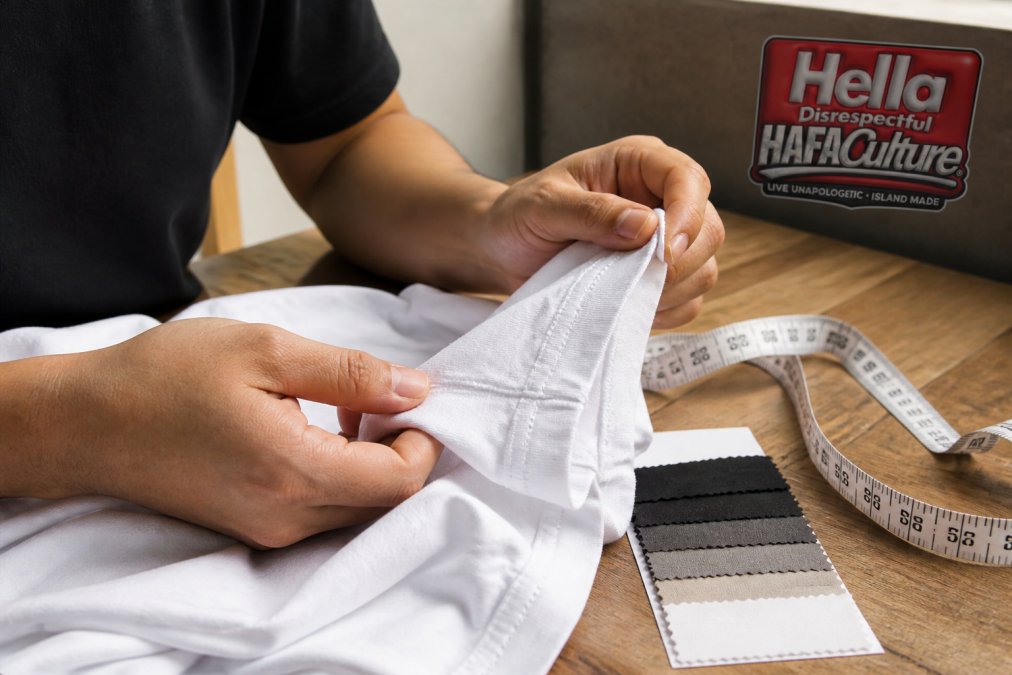
The Touch Test: Hands-On Inspection
The Touch Test is a five-second physical check anyone can run in a store or on a shirt they already own, the fastest way to separate a shirt that will last from one that will not.
What Stitch Density and Seam Type Actually Tell You
Stitch density is a proxy for how much labor and thread a manufacturer was willing to spend. A coverstitch hem, the two parallel lines on the outside of most quality tees, is stronger and more flexible than a single-needle chain stitch because it uses multiple threads and stretches with the knit. A flatlock seam, common on athletic tees, joins panels edge-to-edge with no raised seam, reducing chafing.
How to Prevent T-Shirt Shrinkage and Fading
Shrinkage and fading are preventable, not inevitable. Wash cold, inside out, and tumble dry low or hang dry. Those three habits alone extend a shirt's life dramatically. Heat is the enemy on both fronts: hot water and high dryer settings shrink cotton fibers and break down dye.
A quick reference for keeping tees in rotation:
WANTED: MAC BEAR TEE — PREMIUM →
| Problem | Cause | Fix |
|---|---|---|
| Shrinking | Hot water, high dryer heat | Cold wash, low or hang dry |
| Fading | Dye breakdown from heat and detergent | Inside-out wash, mild detergent |
| Pilling | Short-staple fibers rubbing | Combed cotton, avoid rough drying |
| Print cracking | High heat on DTF or screen print | Inside-out, no direct iron contact |
Fit, Drape, and Neckline Retention
Fit profile and drape separate a shirt that looks intentional from one that looks borrowed. Drape, how fabric falls on the body, is driven by weight and weave: heavyweight drapes with structure, lightweight clings. For a clean streetwear silhouette, you want enough weight that the shirt holds its own shape without feeling stiff.
Price-to-Quality and Sustainability Checks
Cheap tees are rarely actually cheap. A $6 blank that fades in three washes costs more per wear than a $25 shirt that lasts three years. Cost per wear beats sticker price every time, the price-to-quality ratio most shoppers never calculate.
The Diminishing Returns Curve
Price and quality do not rise together forever. The sweet spot for a durable graphic tee sits in the mid-range: roughly $18 to $35. Below that band you are usually paying for thinner fabric, tubular construction, and short-staple cotton. Above roughly $60, you are increasingly paying for brand name, retail markup, and design rather than measurable fabric or construction improvements, a $90 designer tee and a $30 blank from the same mill can use identical 6 oz combed ring-spun cotton and the same coverstitched hems.
Sustainability Certifications Worth Checking
Sustainability is the check most guides gloss over. "Eco-friendly" and "sustainable" are unregulated marketing terms with no legal definition for apparel, while certifications are verifiable. Three are worth knowing:
- GOTS (Global Organic Textile Standard) covers the entire supply chain from organic fiber through finished garment, including social and environmental criteria. If a shirt claims organic cotton, GOTS is the certification that actually backs it up.
- OEKO-TEX Standard 100 tests the finished fabric for harmful substances, things like residual pesticides, heavy metals, and formaldehyde. It is a safety certification, not an organic one, so a shirt can be OEKO-TEX certified without being organic.
- Fair Trade Certified focuses on labor conditions and worker compensation rather than fiber or chemistry. It answers the "who made this and were they paid fairly" question.
Production Model and Waste
How a shirt is made affects both its environmental footprint and its quality control. Print-on-demand production, where shirts are made only after an order comes in, cuts overproduction waste compared to bulk manufacturing, which routinely leaves unsold inventory to be discounted or destroyed. Bulk production achieves lower per-unit costs and tighter consistency but front-loads the waste risk. Neither model is automatically more sustainable; the question is whether the brand can tell you where the blank came from and how the shirt was finished.
Frequently Asked Questions
How do I identify a good quality t-shirt?
Check four things: fabric weight (6.5 oz or heavier for streetwear), fiber type (100% combed ring-spun cotton feels smoother and pills less), seam construction (side-seamed holds shape better than tubular), and stitch density (tighter, even stitches resist tearing). A good quality t-shirt also keeps its neckline after washing. Run your hand across the fabric; if it feels thin or scratchy, it will not survive many washes.
What's better, 100% cotton or 100% polyester?
Neither wins outright. Cotton breathes better, holds a print well, and has a natural hand-feel most people prefer for daily wear. Polyester resists shrinkage and dries faster but traps heat and can feel slick. For custom t-shirts, 100% combed ring-spun cotton is the standard for bold graphics because it takes ink cleanly. Blends like 60% cotton and 40% polyester, used in charcoal heather tees, balance softness with shape retention.
How can you tell if a t-shirt will shrink after one wash?
Look at the fiber content and finishing process. Unmercerized, low-quality cotton can shrink 5-10% after the first hot wash. Pre-shrunk or garment-washed tees shrink far less. To test before buying, tug the fabric gently; if it stretches easily and does not spring back, it will likely lose shape. Washing cold and air-drying prevents most shrinkage in any quality t-shirt.
What is the 3-3-3 rule for men's clothing?
The 3-3-3 rule is a styling guideline, not a quality standard: three colors per outfit, three patterns maximum, and no more than three accessories. It helps keep a look clean. For quality t-shirts, a better framework is checking three fabric specs (weight, fiber, finish), three construction points (seams, collar, hem), and three care habits (cold wash, inside out, low heat dry).
Who sells the best quality t-shirts?
Look for brands that publish fabric weight, fiber content, and construction details instead of vague claims. A quality t-shirt lists specs like 6.5 oz combed ring-spun cotton and side-seamed construction. Independent streetwear labels often beat mass-market brands here because they print on demand and control fabric sourcing. Check the product page for GSM or ounce weight before you buy.
Does fabric weight affect how long a t-shirt lasts?
Yes. Heavier fabric, measured in GSM or ounces, resists pilling, tearing, and thinning far better than lightweight cotton. A 6.5 oz tee withstands repeated washing and holds its structure, while a 3.5-4 oz tee feels flimsy and wears out faster. Heavier fabric also drapes better and holds a bold graphic without the print cracking, which matters for streetwear and custom designs.
How do I check print quality on a custom t-shirt?
Inspect the print edges: a clean, sharp edge means the ink bonded properly. Rub the print firmly with your thumb; if it flakes or lifts, the curing was off. Stretch the fabric under the print slightly; quality prints flex without cracking. DTF and puff prints should feel raised but not stiff. A durable print survives 30 or more washes without fading when washed cold and inside out.