

7 Ethical Sourcing Steps for Island-Inspired Apparel
Last Updated: October 31, 2026
Quick Summary
Ethical sourcing for island-inspired apparel means building clothing around verified labor standards, low-impact materials, and cultural permission, not just island motifs. We treat it as a chain of decisions covering who makes the garment, what it is made from, and who approves the imagery. Write your standards down before contacting any supplier.
- Write a one-page sourcing standard covering materials, labor, traceability, and cultural approval before supplier calls.
- Vet ethical clothing manufacturers by checking labor records, mill names, and audit history in writing.
- Match fabric weight to island climate: lightweight cotton for festivals, sturdier knits for large back prints.
- No ethical fashion certification proves cultural respect, so treat each certificate as one data point.
- Get permission and compensate communities before profiting from a cultural pattern, symbol, or motif.
Table of Contents
- What Ethical Sourcing Means for Island-Inspired Apparel
- Step 1: Define Your Sourcing Standards Before You Contact Anyone
- Step 2: Vet Ethical Clothing Manufacturers
- Step 3: Choose Sustainable Apparel Materials
- Step 4: Check Ethical Fashion Certifications (and What They Do Not Prove)
- Step 5: Build Culturally Respectful Clothing Design Into the Process
- Step 6: Trace Island-Origin Materials and Audit Your Supply Chain
- Step 7: Price Small-Batch Runs and Avoid Greenwashing Claims
- Frequently Asked Questions
What Ethical Sourcing Means for Island-Inspired Apparel
Ethical sourcing for island-inspired apparel is the practice of building clothing around verified labor standards, low-impact materials, and cultural permission, not just island motifs. At Hella Disrespectful Clothing, we treat it as a chain of decisions: who makes the garment, what it is made from, and who gets to approve the imagery on it.
That last part is where most brands fall short. Anyone can print a wave and a palm tree. Fewer can explain where the cotton came from or who signed off on the pattern.
Below, we'll walk through seven steps that take you from blank page to a run you can defend. Each step is short and repeatable.
Step 1: Define Your Sourcing Standards Before You Contact Anyone
Write your standards down before a single supplier call. A written standard turns a vague "we care about ethics" into criteria you can score.
Start with four lines:
- Materials: which fibers you will and won't use
- Labor: what wage and safety baseline you require
- Traceability: how far back you need to see
- Culture: who must approve any cultural design
Keep it to one page. If a supplier can't answer against it, that's your answer.
A common mistake is writing standards after you've fallen for a sample. By then you're negotiating from emotion.
Step 2: Vet Ethical Clothing Manufacturers
Vetting ethical clothing manufacturers means checking a factory's labor records, material sources, and audit history before you place an order. The U.S. Department of Labor guidance on supply chain labor standards is a useful starting point for what decent working conditions actually require.
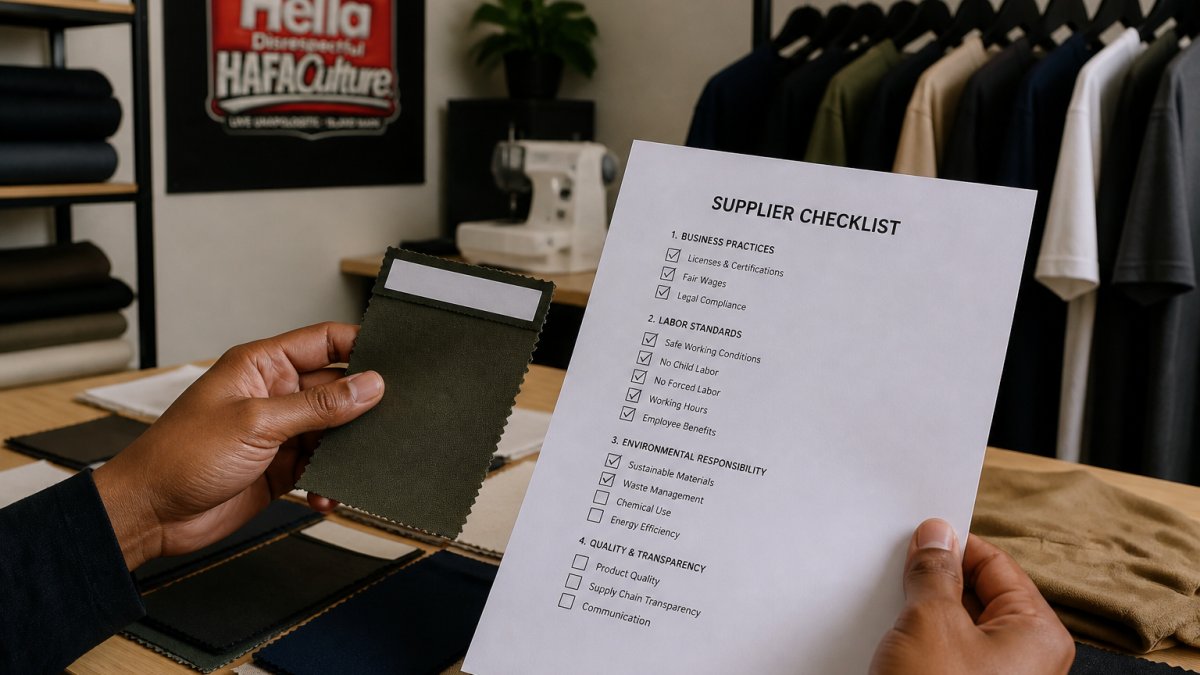
Most sourcing guides stop at "ask for an audit." That is not enough. An audit is a snapshot of one facility on one day, and it rarely covers the subcontractors who actually cut, sew, or print your order. Treat every supplier claim as a hypothesis you have to test.
Questions to Ask Every Supplier
Ask these in writing and keep the replies:
- Who owns the factory, and who audits it?
- What is the starting wage, and when was it last raised?
- Where do your fabrics come from, by mill name?
- Can you show a current audit report?
- What happens when a worker reports a safety problem?
- Which subcontractors touch the garment, and are they named in the audit?
- What is your overtime policy during peak season?
Vague answers are a red flag. Push until you get names and dates.
A Verification Checklist for Supplier Claims
Use this checklist to separate evidence from marketing language before a claim reaches your product page.
- Certificate scope: Does the certificate name the exact facility, product, and material you are buying, or only a parent company or a fiber type?
- Audit date and body: Is the audit less than 12 months old, and who performed it? A self-assessment is not a third-party audit.
- Subcontractor disclosure: Does the audit list every site where your order is cut, sewn, printed, and packed?
- Wage evidence: Can the supplier show payroll records or a wage ladder, not just a stated minimum?
- Material origin: Can the mill name be traced to a farm, recycler, or spinner, and does the transaction certificate match the quantity you ordered?
- Corrective actions: If the last audit found problems, what was fixed, and when?
A certificate answers one question. An organic fiber certificate does not prove fair wages, and a labor audit does not prove material origin. Ask for the document that matches the specific claim you plan to make.
Red Flags That Should End the Conversation
- The supplier cannot name the mill that made the fabric.
- The audit covers a different facility than the one producing your order.
- Wage answers are given as a range with no dates.
- The supplier refuses to disclose subcontractors.
- Sustainability claims appear only in marketing decks, never in documents.
Document every answer in a supplier file. If you cannot defend a claim to a customer, a journalist, or the Federal Trade Commission's guidance on environmental marketing claims, do not make it.
Step 3: Choose Sustainable Apparel Materials
Pick materials for the climate first, then for impact. Island wear has to survive heat, salt, and humidity without falling apart.
Organic cotton breathes well and works for everyday tees. Linen handles heat better than almost anything. Hemp is tough but starts rough. Recycled polyester dries fast and holds print well.
Watch out: cheap blends pill fast in humid air. A heavier knit costs more but lasts.
If printing is part of your plan, it's worth reading whether eco friendly printing alternatives are worth it before you commit to a method.
Matching Fabric to Island Climate and Wear
Match weight to use. Lightweight cotton for festivals, midweight for daily wear, and a sturdier knit for anything with a large back print. Heavyweight holds a big graphic without warping.
Step 4: Check Ethical Fashion Certifications (and What They Do Not Prove)
Ethical fashion certifications are third-party labels that verify specific claims, such as organic fiber content or fair labor practices. They are useful, but none of them certifies cultural respect.
| Certification | What It Covers | What It Does Not Prove |
|---|---|---|
| Organic fiber standard | Fiber grown without synthetic pesticides | Fair wages |
| Fair labor certification | Audited working conditions | Material origin |
| Recycled content standard | Verified recycled input | Factory safety |
| Responsible wool standard | Animal welfare and land care | Cultural permission |
Treat a certificate as one data point. It answers one question, not all of them.
Step 5: Build Culturally Respectful Clothing Design Into the Process
Culturally respectful clothing design means getting permission before you profit from a pattern, symbol, or motif. That's not a legal box to tick. It's a relationship.
The Guåhan Culture Tee carries the latte stone, island silhouette, coordinates, and 671 detailing, and is designed for Chamorros on-island and worldwide.

Put a review step in your calendar:
- Identify every cultural element in the design
- Name the community it comes from
- Ask someone from that community to review it
- Credit and compensate where appropriate
For deeper guidance, read wearing cultural prints respectfully and whether Chamorro prints are offensive. If you're sourcing from island makers, here's how to support Indigenous fashion designers, plus 7 ways to honor Pacific Islander heritage.
Step 6: Trace Island-Origin Materials and Audit Your Supply Chain
Traceability means you can name every hand a material passed through. For island-origin goods, that chain is often short and informal, which makes documentation harder and more important.
Build a simple log for each material:
- Producer name and location
- Date of purchase
- Quantity and price paid
- Transport method
Then audit on a schedule. Visit or video-call the producer, compare output to your log, and re-check labor conditions yearly. The Federal Trade Commission's guidance on environmental marketing claims sets the bar for what you can honestly say about a material's origin.
Step 7: Price Small-Batch Runs and Avoid Greenwashing Claims
Small-batch runs cost more per unit, because setup charges spread across fewer pieces.
The Real Economics of Small-Batch and Local-Producer Sourcing
A simple unit-cost worksheet looks like this:
- Material cost per unit (fabric, trim, labels)
- Labor cost per unit (cut, sew, print, pack)
- Setup cost divided by run size
- Freight and duties per unit
- Payment processing and returns allowance
- Margin that keeps you in business
If a small-batch unit cost looks unaffordable, change the design before you change the supplier. Fewer colors, simpler construction, and a single print location can cut setup costs without squeezing the people making the garment.
Capacity-Building Instead of Extraction
Working responsibly with island-based makers means planning around their capacity rather than testing it. A few practices that hold up:
- Place repeat orders on a predictable schedule so the producer can plan staffing.
- Pay for samples and revisions; sampling is labor.
- Agree on a written quality standard before production so rejects are not a surprise.
- Ask what the producer wants to grow into, and place orders that support it.
Keeping Claims Tight Enough to Defend
Only make material and sourcing claims you can document with a certificate or audit.
Before any claim goes live, run it through three questions:
- What document proves this claim?
- Does the document cover the exact product and facility?
- Would I be comfortable if a customer asked for the proof?
If any answer is no, rewrite the claim until it is.
Frequently Asked Questions
What does ethical sourcing mean in clothing?
Ethical sourcing in clothing means knowing who makes your garments, where the fabric comes from, and under what conditions people work. It covers fair wages, safe working conditions, verified suppliers, and lower-impact materials. For island-inspired apparel it also means confirming that cultural imagery was used with permission and that island-origin materials can be traced. Ethical sourcing is a documented process, not a claim on a hangtag: you should be able to name your factory, your fabric mill, and the standard each one was checked against.
How can apparel brands verify that their materials are ethically sourced?
Ask for paperwork, then check it. Request material certificates, mill names, and transaction records that connect the fabric to the finished garment. Visit or hire a third party to audit the factory, and confirm labor standards are written into your purchase order. Keep a file per supplier with audit dates and renewal deadlines. If a supplier cannot name their own mill, treat the sourcing claim as unverified. Traceability is the test: a supplier who can walk you from fiber to finished tee is a supplier worth keeping.
What certifications should I look for when sourcing sustainable clothing?
Look for certifications that match the specific claim you want to make. Organic fiber content, recycled content, fair labor, and chemical safety each have separate programs, and no single certification covers everything. Read the scope statement on each certificate to see what was actually audited, and check the certificate's expiry date and the facility name against your supplier. A certification logo alone proves little if it was issued to a different factory or a different product line than the one you are buying.
How can brands represent cultural heritage respectfully in clothing design?
Start with permission and payment. Work with artists or community members from the culture you are referencing, credit them, and compensate them. Avoid sacred symbols, and skip patterns you cannot explain or source. For island-inspired apparel, that means knowing what a latte stone or a voyaging canoe represents before printing it. Respectful design also means hiring from the community where possible and letting people from that culture review the artwork before it goes to production.
